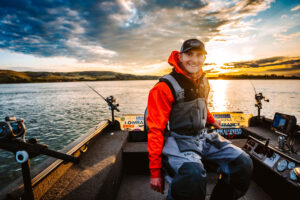
When anglers think of muskie fishing, they likely think of northern Minnesota, Wisconsin, or Ontario as some of the top muskie fishing opportunities. While this is true, many anglers are surprised they have the opportunity to catch a muskie in eastern South Dakota as well.
The South Dakota muskie program began in 1975, when South Dakota Game, Fish and Parks (GFP) accepted 2,000 muskies from Valley City National Fish Hatchery in North Dakota. These fish were stocked in Amsden Dam, and was the only muskie population in South Dakota for 25 years.
In 2001, muskies were stocked in Lynn Lake, which became the first of the current five muskie fisheries. To date, muskie are present in Lynn Lake, Middle Lynn Lake, West 81 Lake, Lake Sinai, and North Island Lake.
All of these populations are maintained by stocking, and muskie fingerlings are provided to GFP every July from the Iowa Department of Natural Resources. These muskie fingerlings are then transported to Blue Dog State Fish Hatchery near Waubay, where they spend the summer in one of the fish rearing ponds being fed fathead minnows.
In October, the pond is harvested and fish are stocked. Generally speaking, muskies are about 13 inches when they are stocked. Fish are stocked approximately one fish per acre, which means about 1,600 muskies would be stocked in a fishery like Lynn Lake.
The goal of the muskie program is to provide a quality fishing opportunity that is unique in the state, and ultimately provide anglers the opportunity to catch a muskie in South Dakota. This is done by maintaining low density populations, with the target goal of one muskie per five acres across a fishery.
The best muskie population data comes from Lynn Lake, as GFP fisheries biologists sample muskie while conducting walleye spawning operations. Both muskies and walleye are captured in large frame nets that include a 100 foot lead.

This is the same muskie net used in Minnesota, and research has determined this net is more successful at catching fish than the previous standard net in South Dakota. The Minnesota style nets have been incorporated since 2013.
When muskie are stocked a special tag is placed in the fish for identification when recaptured. This identification has determined that muskie are reaching approximately 34 inches by age-5, which is average growth rates for a muskie population.

Muskie may live up to 25 years in South Dakota, and the population as a whole displays older fish with limited recruitment. GFP has continued to experiment with stocking timing, sizes, and rates to increase recruitment.
Muskie populations have been catch and release since 2018, and anglers are still eligible to submit fish for the Proud Angler program for catch and release lengths. The majority of fish reported are between 40-45 inches, with a few fish exceeding 45 inches.
While anglers will need to put in a serious effort, the opportunity to catch a muskie exists in eastern South Dakota. There are a number of fishing opportunities present across the state, and the muskie fisheries provide yet another unique species for anglers to pursue.

All Images Courtesy South Dakota Game, Fish and Parks Facebook Page
South Dakota Muskie Fishing Frequently Asked Questions
What Lakes Have Muskies?
Currently there are five lakes in South Dakota that have muskie populations:
- Lynn Lake (Stocking began in 2001)
- Middle Lynn Lake (Stocking began in 2015, fish were likely present from Lynn Lake)
- West 81 Lake (Stocking began in 2005)
- North Island Lake (Stocking began in 2009)
- Lake Sinai (Stocking began in 2011)
Lynn Lake and Middle Lake provide two of the best opportunities to target muskies.
Can You Keep a Muskie in South Dakota?
No, all South Dakota muskie fishing is catch and release only.
Anglers may still submit muskies for Proud Angler awards based on the fish’s length.
Do Muskies Naturally Reproduce in South Dakota?
No, all muskie populations are maintained through stocking efforts.
Where Does South Dakota Receive Muskies From?
Muskies stocked in South Dakota are received from the Iowa Department of Natural Resources, and are then reared at Blue Dog State Fish Hatchery.