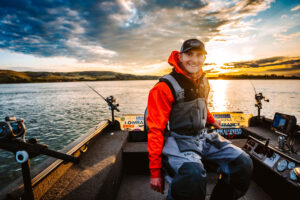
Northeast South Dakota, commonly referred to as the Glacial Lakes region, is known for excellent walleye and yellow perch fishing. While these fishing opportunities get much of the attention, the area also provides fantastic bluegill fishing as well.
There are a number of ways to target bluegill in northeast South Dakota, and three of the best ways include slipbobbers and livebait, jigs and plastics, and even small crankbaits. Regardless how you wish to target bluegill, you’re likely to find success!
Slipbobber Strategies
The simplest, and most common, way to target bluegill is with slipbobbers. A simple technique that can have a number of variations in ways to rig it, the preferred method is a slipbobber tie, bead, slipbobber, and ⅛ ounce egg sinker on the main line. This is connected to a leader through a barrel swivel, with 4-8 pound fluorocarbon leaderline to a size 6 or 8 octopus or aberdeen hook.
Livebait is the most common option to fish under a slipbobber, and in the terms of simplicity it’s tough to beat a traditional nightcrawler. In addition to nightcrawlers, when anglers can get their hands on them, wax worms, spikes, or even leeches can produce as well.

The best bluegill fisheries in northeast South Dakota feature an abundance of vegetation with very clear water. This is the habitat conditions bluegills prefer, and this is what makes slipbobbers so effective. Slipbobbers allow anglers to hang their baits between the weed stalks where the bluegill are feeding.
Slipbobbers and livebait often provide the best numbers bite, but with this comes a number of smaller fish as well. While 7-9 inch bluegill are present in many fisheries across the Glacial Lakes region, with larger fish available too, there are also good numbers of fish between 3-6 inches that are eager to strike a crawler under a bobber.
Slipbobbers also bring a greater number of fish that can be deep hooked. While this is less of an issue for anglers wishing to keep fish for a meal, anglers wishing to practice catch and release will find themselves cutting their hooks more and the inevitable deep hooked fish. Upsizing hooks can help with this, but at the risk of missing more bites.

Powering Up with Plastics
One of the best ways to address the weaknesses of slipbobbering is by powering up your presentation with plastics. Fishing with light jigs, usually 1/16 ounce, and small plastics can be one of the most efficient and effective ways to target larger bluegills.
The greatest asset plastics present is the challenge of stolen bait being mitigated greatly. When slipbobbering, the smaller bluegill and bites that don’t get hooked often result in the loss of nightcrawler or other livebait, which leaves your presentation effectively useless.
Fishing with plastics addresses this, because while it is possible for a plastic to be pulled down or off the jighead, it’s significantly harder than a traditional livebait option under a bobber. This means that missed bites aren’t missed opportunities, and anglers can keep effectively fishing when they might otherwise need to be reeling in to rebait.
Plastics, even smaller ones, can help draw bites from larger bluegill. The slightly larger profile can provide an enticing meal to the larger fish, and result in more bites from larger fish as opposed to smaller fish taking swipes at a live bait option.
Another component that makes fishing a plastic effective is the ability to cover more water. While a slipbobber can focus on one area, jigs and plastics can be casted and retrieved in a way that can cover more water and contact fish more quickly. Of course, jigs and plastics can also be fished vertically as well once fish are contacted.
The final component is the reduction of deep hooked fish. The jigs and plastics often result in clean hooksets, and greatly reduced deep hooked fish. This is great for anglers wishing to catch and release, and safely release smaller or larger bluegill.

Cranking Up Success
Anglers wishing to take their bluegill fishing to the next level will also find success casting small crankbaits such as the Salmo Hornet or Berkley Shallow Money Badger. While panfish may not be considered a predator, larger bluegill will strike at larger crankbaits and both bass and walleye anglers may be surprised by the size of crankbaits that bluegill are willing to bite.

While these may be anomalies, anglers can realistically target larger sized bluegill with smaller crankbaits. The smaller profiles of the Hornet and Shallow Money Badger, with sizes down to 3.5 to 4 depending on the bait, are ideal for both bluegill and crappie.
Casting these crankbaits is one of the most effective ways to cover water, contact fish, then follow up with either slipbobbers or jigs and plastics. Anglers fishing for the largest bluegills in the fishery will likely find their best success casting these small crankbaits the entire time.
Similarly to fishing with jigs and plastics, anglers can have little concern about deep hooked fish when fishing with these small crankbaits and for the most part all fish caught should be reasonably releasable.
It’s easy to consider a bluegill a forage source for bass, northern pike, and walleye, but the fact is that larger bluegill are predators in their own right. These fish are more than willing and able to aggressively chase and strike these baits, which can resemble young-of-the-year fish or minnow species that these larger bluegill may feed on.
It’s also important to note that, as the anglers may be surprised by bluegills on their larger bait, bluegill can be incredibly curious fish and strike just to determine what something may be. The aggressive action, flash, and vibration can all attract fish from a distance and draw curiosity strikes as much as feeding strikes.

The most successful anglers will integrate all three of these presentations for their specific situations. While fishing preference is certainly a factor, and some anglers will be more confident with jigs and plastics and some may be more confident with small crankbaits, all three techniques can be effective.
Whether you’re seeking a true trophy caliber bluegill, or just want to catch a bunch of quality fish, there’s a bite waiting for you in the Glacial Lakes region of South Dakota. Slipbobbers, jigs and plastics, and small crankbaits can all produce exactly that, and anglers should be prepared to utilize all three methods to maximize their success bluegill fishing northeast South Dakota!