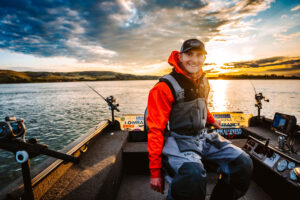
The Glacial Lakes region of South Dakota is known for walleye and perch fishing, but there are excellent fishing opportunities for a number of species. Specifically, several fisheries offer spectacular bluegill and bass fishing.
The emergence of curly-leaf pondweed has contributed to the increasing abundance of bluegill, largemouth bass, and yellow perch. In some instances, such as Big Stone Lake, traditional walleye fisheries have begun to function as more bass/bluegill fisheries due to these changes with walleyes offering an additional opportunity as a bonus fish.
This is because the curly-leaf pondweed begins to grow until the ice, and can dominate the vegetation of the fishery throughout the late ice, spring, and summer seasons. By early July, the weeds will begin to die and produce large mats of vegetation on the surface of the water.
These weed conditions are ideal for yellow perch to hang their egg sacks, as well as for both bluegill and largemouth bass. However, these conditions are less optimal for walleye, and thus why these fisheries have transitioned toward primarily bass and bluegill opportunities. Fortunately, this has also set up for many excellent multispecies fisheries.
Big Stone Lake
Big Stone Lake offers the best multispecies fishing in the region. Anglers can target walleye, yellow perch, bluegill, largemouth bass, and even newly re-introduced lake sturgeon.
Traditionally a walleye fishery, overall walleye abundance has decreased in recent years. The majority of these fish are of the eater caliber, between 14-17 inches, and are trending toward providing more of a bonus species as opposed to primary target. Fortunately, this walleye fishery is supported by stockings by South Dakota Game, Fish and Parks (GFP).
Yellow perch continue to provide an angling opportunity as well, though these populations have been cyclic. At times, perch abundance has been very high but there can also be lower abundance periods as well. Many of these perch are generally between 6-10 inches.
Bluegill abundance continues to be on the upward trend, with incredible abundance of quality sized fish as well. Big Stone Lake has turned into a destination bluegill fishery, as anglers can expect numerous 6-9 inch fish, with bluegills up to 11 inches as well.
These bluegill are growing extremely quickly, reaching 8 inches by age-4. This means that as bluegills are harvested by anglers, there are fish coming up the ranks ready to replace them. The combination of high abundance, high growth rates, and top-end trophy potential has set up for one of the best bluegill fisheries in the state, if not the region.
Hand in hand with the bluegill fishery, the largemouth bass population is doing extremely well. Anglers will find bass of all sizes in good numbers, and Big Stone Lake has become the most popular bass lake in South Dakota.
One of the best stories out of the fishery is the return of the lake sturgeon. Reintroduction efforts started in 2014 with 4,000 fish stocked each year. The population has exceeded expectations to the point these stockings will now be every three years as opposed to every year, with the population naturally reproducing and supporting itself.
Sturgeon anglers can reasonably expect to target these fish and catch them. The lake sturgeon abundance is high, with fish of all sizes all the way up to 60 inches. Lake sturgeon are growing quickly, and as a whole the population is in tremendous shape.
Roy Lake
Further north, Roy Lake offers another excellent multispecies fishing opportunity. Anglers will find excellent bluegill fishing, with quality crappies as bonus fish as well. Bluegill between 6-9 inches are common, along with fish surpassing the 9 inch mark too.
Walleye anglers will also find success, and while walleyes are not in high abundance anglers can find quality sized fish. The same can be said for smallmouth bass too, with large smallmouth bass present in the fishery. Northern pike are also present in good numbers too.

Lake Albert
Closer to Watertown, sitting in the shadow of Lake Poinsett is Lake Albert, which can produce quietly very good fishing. Anglers will find fair numbers of walleye, large sized northern pike, and a boom and bust perch population that can produce good fishing in certain years.
Lake Sinai
Heading towards Brookings, Lake Sinai provides another excellent multispecies fishery. Smallmouth bass fishing can be very good, with quality fish to be caught. Walleye, while difficult to target, can be present in both eater and trophy caliber sizes.
Crappie and yellow perch can also provide very good fishing opportunities, particularly throughout the ice season.
Clear Lake (Marshall County)
Clear Lake in Marshall County offers a number of species including walleye, northern pike, black crappie, and bluegill.
Walleye are present in low abundance, with most fish between 14-18 inches but reaching trophy caliber sizes in low numbers too. Contrary to other local fisheries, Clear Lake does not have boom and bust year classes but rather a small trickle of fish every year. This means that year classes spanning a decade can be found, which means fish of all sizes are present in the system on any given year.
The bluegill abundance continues to increase, with many fish between 6-8 inches and surpassing 9 inches as well. The increased number of fish means that growth rates are relatively slow, with fish taking 7 years to reach the 8 inch mark.
Anglers harvest only a small fraction of the bluegill within the fishery. This means there is a surplus of fish for anglers looking to enjoy a fish fry, and bluegill harvest between that 6-8 inch mark is encouraged. Releasing the larger bluegill, those greater than 9 inches, will also support growth rates and size structure.
Largemouth bass are present in good abundance, with fish of all different size classes. The same can be said for northern pike, with a high abundance of pike of all sizes up to near the 40 inch mark. Black crappie can also provide another species to target as well.
Cattail/Kettle Lake
Cattail/Kettle provides anglers the opportunity to catch quality sized walleyes, bluegills, and yellow perch.
Walleyes see a fast growth rate, reaching 19 inches by age-4. While at relatively low abundance, this growth rate has many fish between 18-24 inches to be caught.
Bluegill and yellow perch are both present in moderate abundance as well. Similar to Roy Lake, aquatic vegetation is continue to increase and the lake is slowly transitioning into a more traditional bass and bluegill fishery.
Additional lakes that provide multispecies fishing include Pickerel Lake, North and South Buffalo lakes, and Enemy Swim Lake. Horseshoe Lake also can provide excellent bass fishing as well.
The Glacial Lakes region of South Dakota is home to a number of waterbodies, and in a turn a number of different fisheries. Whether you are targeting a walleye, yellow perch, bluegill, largemouth bass, smallmouth bass, or even lake sturgeon there are angling opportunities waiting for you to enjoy!