
The early spring is always brought with new excitement – warmer weather, the (hopefully!) end of winter, and a new open water season! When the ice subsides, boat docks are placed, and weather allows, anglers will take to the Missouri River in number. While the bite can be very good in the early spring, sometimes the fish aren’t quite as excited as the anglers are for the start of the season. When the bite is tough, that’s when changing techniques can produce fish!
This was the exact situation I was facing to kick off the 2026 open water season. The weather was beautiful with temperatures in the 80s, high sun, and no wind, but everyone I talked to reported a tough bite on Lake Sharpe. Fortunately, I’ve learned a few ways to approach this the past few years, and I had these lessons reiterated to me as I successfully found a limit of fish!
Cover Water, Cover Water, Cover Water
This is my number one rule, whether it’s my first time on the water in a while or a new waterbody the best thing I can do is cover water and pay attention to what I’m seeing. The most important factors on the Missouri River reservoirs are water clarity and current, and this is especially true in the early spring. These two factors will set the tone for the day.
When the current is steady, I focus my efforts on areas that see the most current. This is often adjacent to the main channel, and also natural pinch points that current will be most increased. In these areas, I then pay attention to the water clarity and find the clearest water possible.
What I was seeing was clear water, as we haven’t had much snow and in turn minimal runoff, and the current was pumping fairly steady. The final factor is then trusting my gut what I’m seeing on my graph, if I don’t see fish I keep going. When I do see fish, I troll crankbaits a little ways to see if they’re willing to bite, but after 20 or so minutes if there’s no bites it’s time to hit the next spot.
Trolling crankbaits is my top option for this scenario, as it allows me to cover water and target aggressive fish. Moving often around 2 miles per hour, I’m able to both graph and see if any fish are willing to reveal themselves to me. Anytime I’m looking for fish, I’m pulling cranks behind the boat for these reasons.
This day in particular I started by fishing one of my best confidence spots, but that didn’t prove successful and after about a half hour I knew it was time to start working my way downriver. I graphed three other spots before giving about 20 minutes on another spot unsuccessfully, this led me down to another area that has proven successful in the early spring for me in previous seasons.
Trust Your Notes
I’m a big time note taker, in fact you’re essentially reading them right now, and most importantly I trust my notes. While each year brings new variables, seasonal patterns and movements often hold true. The same areas are generally productive year after year, or at minimum areas that look similar to these areas can be productive. Last year, the conditions were near identical and I was fortunate to find some really quality fish in this particular area.

While I found fish in a very similar location, in fact according to my graph I was only about a mile up from where I caught them this time last year, it was the presentation that proved to be the determining factor for success.
Balsa Beats the Rattles in Early Spring
Last year, I found that the most productive baits were balsa baits. I love pulling #5 Berkley Flicker Shads on Lake Sharpe, but I’ve found that that when the water is very clear and the sun is high the best approach is to use a #5 Rapala Shad Rap.
Shad Raps don’t feature a rattle component, and the action is a tight wobble. For these factors, I term it a “quiet” presentation. This allows me to trigger fish that are possibly a bit more inactive or neutral, while taking advantage of the clear water for fish to see my presentation from a distance should they want to strike.
Minor Details Result in Major Success
Generally speaking, my two favorite colors are purple and blue on the Missouri River. I started the day by fishing a Purpledescent Shad Rap on a planar board and a Blue Shad Rap on my inside rod off the back of the boat. I felt like the clear water might be making fish boat shy, so I put my Purpledescent a little bit higher in the water column and sent the planar board well up towards the flat.
I was very wrong. I fished that planar board at a variety of depths and a variety of distances and it never got touched. Fortunately, that’s why we try a variety of presentations. My inside rod, which I had a consistent 65 feet back, finally doubled over. Unfortunately, I’d had my drag tightened way too tight, and the fish popped off.
I had only had one bite, but I instantly began to analyze it. The bite occurred when I was in 9-10 feet, as I had been weaving the contours of 8-12 feet, and on my Blue Shad Rap. I reset the bait to the same depth, 65 feet, and pulled specifically in the 9-10 foot range. Only a few minutes later, I had my first fish of the day in the boat.
This told my two things – the Blue Shad Rap was going to catch fish and I needed to focus on this 9-10 foot depth range. After focusing my whole afternoon trying to dial my planar board in, it was the other presentation that ultimately was starting to produce.
I felt confident enough I was starting to get something dialed in that I ran back to the start of my pass and rigged up another #5 Shad Rap in a slightly different blue, Helsinki Shad, to fish side by side.
I set both the baits out at 65 feet, held the boat in the 9-10 foot depth range, and started to get my equipment put together to film a video. The fish had other plans, and I doubled up in short order before I could even get my gear ready! This proved to me that all the adjustments I had made were correct, and most importantly they were putting fish in the boat for me.
The bite wasn’t fast, and it didn’t help I got myself a bit distracted trying to film my video, but sure enough I was able to put my fourth fish in the boat. It required covering a lot of water, trusting my electronics, trusting my notes, and paying attention to what the fish told me, but when you put all those pieces together and put a limit of 15 ¾ – 17 ¾ inch walleye in the livewell, it makes it that much more rewarding. Good fishing!

Watch It: Finding Finicky Spring Walleye on the Missouri River
Check out that video, Finding Finicky Spring Walleye on the Missouri River, and get an on the water look at the action from the day!
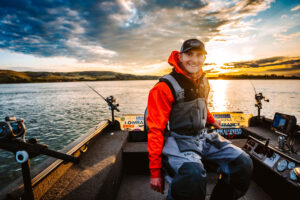

[…] Reports from anglers on Lake Sharpe have been that the fishing is tough, but there are still fish to be caught! This was the theme of this week’s highlight, Finding Finicky Spring Walleye on the Missouri River. […]