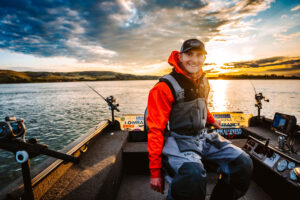
Lake Oahe is a large and expansive reservoir that features numerous structural elements including points, humps, islands, flats, and hundreds of creeks and other tributaries. Reaching depths of greater than 100 feet all along the reservoir, there is no shortage of water to try to find walleye.
To further complicate the fishery, once fish are located the term “here today, gone tomorrow” often steals the show. This means that putting together a replicable pattern is critical. Anglers who are able to dial in a consistent pattern, and put it into place each day on the water, are going to find the greatest success. Fortunately, throughout the summer months there are multiple patterns that can develop along the fishery.
When it comes to discovering and developing these patterns, there are three factors that need to be determined. These include: location of the forage, structural characteristics, and depth. All three of these factors have different elements within them and interweave together. Let’s take a deep dive into each of these factors.

Location of Forage
Locating the forage is the single most important factor when it comes to fishing Lake Oahe. If the forage is not present, the fish aren’t going to be either. Predators, in this case walleyes, must be near their prey. In Lake Oahe, that prey is predominantly rainbow smelt, gizzard shad, and lake herring. Young of the year fish, including white bass, freshwater drum, crappie, yellow perch, and other juvenile fish of other species all present forage options as well.
This diversity of forage in the system means the location of it is going to be diverse as well. For example, gizzard shad prefer warm water and are likely to stay shallower throughout the bulk of the summer whereas rainbow smelt and lake herring will be seeking cold water to stay comfortable. This means there could be forage both in the deep water and shallow water at the same time.
Another example would be as spawns are completed, these young of the year fish are going to be entering the system at different times. For example, northern pike spawn very early in the season. By contrast, yellow perch, crappie, and freshwater drum will spawn later in the season. This means that in July and August young of the year fish may still be playing a critical role in the location of walleye.
To put this into practice, let’s look at an example for mid-summer. In the Mobridge area, young of the year freshwater drum, yellow perch, crappie, and white bass may be working their way out of the Grand and Moreau Rivers towards the main basin. These young of the year fish were spawned in these large tributaries, and were using the nursery habitat within the tributary. Now the temperatures are increasing, and these fish are working their way towards the cooler, deeper main river. Walleye will likely be sitting out these tributaries waiting for their meals to come to them.
Further down the reservoir, cold water species such as rainbow smelt and lake herring are sitting out in the deeper water, likely in depths between 30-60 feet. These fish are holding off secondary points, and there are trophy caliber walleyes sitting out in these depths following these fish. Near the same areas, but in significantly shallower water. Gizzard shad are staying in less than 30 feet, and there is a good abundance of 15-18 inch fish staying near these schools.
All of these scenarios could be playing out at the same time, even in similar areas of the reservoir. The primary key is to locate this forage and see where it is sitting. The better you understand the dynamics of movement of each individual forage species, the better you’ll be able to estimate the type and quality of fish that will be holding near each.

Structural Characteristics
The next part of the equation is understanding structural characteristics. There is no shortage of structure within Lake Oahe and it would take a lifetime to fish it all, nonetheless in a day. Anglers who are able to categorize and decipher certain types of structural elements, and factor that in with where the bait is holding are going to be the most successful.
Early in the season, the creeks and tributaries play a major role in location. Fish will move into these areas to spawn, and whether it’s the Grand River, Moreau River, or Cheyenne River or one of the hundreds of smaller creeks and tributaries this is likely where fish will be holding until about June. At this time, fish will begin moving both down the reservoir and out of the creeks. This sets up a situation where fish are constantly cycling through areas.
Early in the season, fishing within these areas is best. As the summer goes on, the points and structural elements adjacent to these areas will be the most productive. Main lake structure, such as the large flats and submerged islands, will also come into play. Putting this all together, anglers must first determine whether they are fishing in the creeks or on the main body.
Once this has been determined, the next step is identifying structural elements that look similar. A good example of this would be the long finger points that come out further into the main river. The longer the point, generally the more productive it is. Areas that have deeper subpoints will also be effective, particularly throughout the middle of summer. More classic flats, such as Mission Flats, Sully Flats, and Peoria Flats also have their own similar characteristics.
Whether it is a flat, long point, cup or cove, or other similar structural element when fish are found on one piece they are often found on the other. Of course, the key is if the bait fish are present. For example, a long finger point south of Agency Creek will likely be just as productive as a long finger point coming off Chantier Creek. While these may be miles away from each other, the concept remains the same-similar looking structure adjacent to similar sized tributaries.

Depth
Depth is the final element to this equation, and it can be broken down into two separate categories. The first is how deep of water you want to be in, the second is how deep of water the fish are holding in. Similar to other big water fisheries, Lake Oahe walleye will often suspend off of structure in deep water. This means you need to be cognizant of both where you are and where the fish are.
The first aspect to consider is how deep to position yourself and where to start your search. This is going to be largely determined by the first two elements-forage and structure. The forage is pretty simple, the depths holding the forage is going to be the same depth holding walleye. If you are seeing forage in the top 10-30 feet on your graph, you can expect walleyes to be in that ballpark too. When the forage is deeper than that, say 30-50, well the walleyes are going to be diving with them too.
The structure will also play a role as well. For example, a shallow point will generally hold fish a bit shallower, particularly when there is a good wind blowing onto it. A deep water structural element, such as Fantasy Island, that only gets so shallow will also be a limiting factor. On these pieces of structure, water levels are going to determine depth. This won’t stop fish from utilizing it, just will change the approach you take when you fish it.
The second aspect is what will determine your presentation. If the fish are holding within about two feet of the bottom, bottom bouncing is going to be your best option. When they are suspended, particularly in less than 30 feet, you’re going to have more success trolling crankbaits. When they are suspended deeper than 30, your best bet is going to be fishing vertically with jigs or spoons or a front-facing sonar approach.

Putting It All Together
Now let’s put this all together with a couple examples. Lake Oahe can be a complex fishery, but when you break it down there can be a few relatively simple approaches that can catch a lot of fish. Let’s look at a few of them.
Our first example is a shallow main lake point below a major tributary. There’s an abundance of bait between 10-30 feet suspended in the water column adjacent to it, and the wind is blowing onto it at the perfect angle. Start your search for walleye in 10-15 feet of water, and you’re likely to find them holding tight to the bottom. This is a perfect bottom bouncing scenario and will likely see a good number of 15-20 inch fish.
The second example is a main lake flat. There’s forage on both the shallow and deep sides of it, likely gizzard shad shallow and smelt deeper. Fish are staging behind the shad, which are over 25 feet of water but holding between 15-20 feet as they follow the bait. This is an ideal situation to troll crankbaits, and it can be expected to see plenty of fish between 18-23 inches.

The third example is a deep sub point. The forage is positioned out deep, between 30-50 feet, and the fish have followed. You’re not seeing anything in less than 30 feet off the primary point, and you are seeing both big marks and forage out on the deeper sub point. This is a time to get vertical and target these suspended fish with jigs, spoons, or other vertical presentations. This is also when anglers that utilize front facing sonar are likely to do best. There’s a good chance at a trophy caliber walleye finding the boat!
Lake Oahe is a big water fishery, with no shortage of structure, forage, and walleyes. Putting all these factors together can be a challenge, especially if you look at it as a waterbody as a whole. When you break it down into certain areas, look for similar structural elements, and can recognize the three factors that set up patterns you can find fish relatively quickly on any given day, in any given location. Keep an eye on the forage, identify areas that look similar on your map, and let both of these tell you what depth to target. Put together a pattern on Lake Oahe, and you’re going to have some of the best fishing you’ve ever experienced!
See It in Action: Patterning Summer Walleye on Lake Oahe
If you’re looking to see it all come together, check out this YouTube video, Patterning Summer Walleye on Lake Oahe. Here you’ll see the structure on the map, what the forage and fish look like on the sonar, and how that impacts presentation and approach. We’re working on expanding the YouTube portfolio and hope you find this useful to see everything in action!