
There are a number of fisheries that can be relatively simple to pattern. Fish will likely be in one area in the spring, perhaps limited spawning structure, before transitioning through breaklines and weed edges and spending the summer on some main lake structure. These are likely smaller fisheries, are home to a relatively simple fish community, and for whatever other reasons may be rather simple to pattern. The Missouri River reservoirs are not one of these.
The Missouri River reservoirs are complex fisheries. They are home to a wide variety of species, feature several forage options, and are impacted by runoff across the entire watershed. Add in the fact these fisheries are large, deep, and feature an incredible amount of structure and it’s easy to understand what makes these fisheries difficult to pattern.

Whether it’s the amount of snowpack in the upper rocky mountains impacting lake elevations and/or the amount of current flowing through the system, prairie snowpack and spring rain storms impacting water clarity and localized runoff, and the complex relationships between smelt and ciscoe, dynamics of gizzard shad populations, and the spawning success of white bass, crappie, yellow perch, freshwater drum, and more impacting the forage options and anglers have a lot to consider.
It’s complex, it’s dynamic, and it can’t even be summed up in one long, ugly run-on sentence! That’s not even including seasonal weather patterns, which on the prairie is an average of the extremes.
Anglers that can understand all of this, and pattern fish year in and year out based on it, are crazy. This is because there’s maybe one I can think of that can do it, and it’s not me! For the rest of us, there’s a couple different things we can do to help us do our best to pattern where fish may be on any given year. Sprinkle in some luck, and we just might find some success!

Colorful Charts and Way More Waypoints
The first step I take is to turn my map on my graph into my own personal Dewey Decimal System. My current boat I got new in 2020, which included a new graph, and from there I’ve built my own waypoint system that has helped me find fish each year.
There are certain areas that will hold fish consistently every year. The Chamberlain area in the spring time, West Bend area in the summer on Lake Sharpe, and the Akaska to Whitlock/Sutton Bay area on Lake Oahe are all good examples. Anglers can reasonably expect to find fish in these areas at their respective timelines, and often find fish in the same types of areas.
However, even in these areas, fish are going to be holding and moving through different spots in any given year. Sometimes this changes on a week to week basis, sometimes we’re lucky and it’s month to month, and other times it’s day to day or even hour to hour. This is where my waypoint system comes in.
I have two considerations when I make my waypoints on my graph. The first is color, the second is symbol. My color remains consistent, each based on the technique that was produced for me. The symbol changes year to year. When you have multiple years’ worth of data on one map, you can begin to see patterns emerge.
In terms of color, blue waypoints are for bottom bouncing fish, red waypoints are for trolling fish, pink waypoints are vertical jig fish, and yellow waypoints are pitching/casting fish. On some areas, these colors may overlap, and even change by the season, on other areas they may all be one color.
Special colors also help me identify when I incidentally catch other species. For example, green spots are largemouth or smallmouth bass, turquoise for northern pike, and white for panfish or white bass. Knowing the areas these other species are using helps me understand the fishery as a whole just a bit better.
Nick’s Waypoint Colors:
- Blue = Bottom Bouncing
- Red = Trolling Crankbaits
- Pink = Vertical Techniques (Vertical Jigging or Jigging Spoons/Glidebaits)
- Yellow = Pitching/Casting (Jigs, Crankbaits, or Slipbobbers)
- Green = Bass (Largemouth or Smallmouth Bass)
- Turquoise = Northern Pike
- White = Panfish or White Bass
In terms of symbols, I change this every year. In 2020, my first year with the boat, I used circles. In 2021 diamonds, 2022 fish icons, 2023 was tents, 2024 was stars, 2025 was sailboats, and 2026 was dollar signs. After compiling this much information, patterns emerge, but often will find themselves in slightly different areas.
For example, in 2025 I enjoyed an excellent trolling bite throughout the spring and early summer. The vast majority of these waypoints are in 6-7 feet. In 2026, while I’ve caught fish in the same area of the reservoir, for whatever reason the fish are holding in 9-12 feet instead of up shallower. The takeaway is that the same area held fish, at the same time, but for whatever reason one year they were sitting shallower and the other year they were sitting deeper.
On Lake Oahe, fluctuating water levels has literally put a few of my waypoints from high water years on land in low water years. Conversely, structure that was too deep to find during these high water years begins to be the primary focus in a low water year. This system allows me to know what year I was finding fish where, and identify areas that may be holding fish based on what my current water levels I am fishing in are.
Over six years, I have over 4,000 waypoints on my graph. Many people will think this is excessive and a waste of time. I disagree. If I’m in position to do so, I try to drop a waypoint for many of the fish I catch. The reason is not so I can go waypoint to waypoint on my next pass, but to identify these trends.
When you do this, you’re likely to find areas that the most fish come from. There’s good fishing spots, but the great fishing spots are often within these good spots. Some anglers may refer to this as the “spot within the spot.” Whatever you call it, when you go back and inspect these trends you’ll likely find whatever makes this area slightly better than the rest. Perhaps it’s a micro-point within a point, it could be a small area of stumps, or maybe it’s a rock pile. Whatever it may be, it’s an area that you’ll be able to identify faster based on this system.
This is important because a long area that presents as a trolling stretch may have hidden areas that vertical jigging can be incredibly efficient and productive. A long point for bottom bouncing may have a micro-point within it that you can pitch jigs, cast crankbaits, or slipbobber. Maybe an area of larger boulders stands out as an ideal casting spot within a long rocky shoreline. Whatever you find, it’s going to be valuable!
Another important component of this mapping is identifying the productive water versus the unproductive water. I’ll commonly refer to “trying to extend the pass.” This means that I’m trying to see if I continue on whatever area or piece of structure I may be fishing to see if I can continue to get bites. If I continue past my last waypoint and find more fish, I know I can continue that pass in tough fishing conditions. Conversely, if I get past my last waypoint and don’t have any other bites, I know I need to focus on a certain area.

Anglers that use their waypoints as bread crumbs to try to follow a trail between fish will likely fail to fully graph the piece of structure they are fishing, and will likely never get their baits in front of some fish. Conversely, anglers who use their waypoints to put together their own personal map, and identify trends among fish movements and productive areas on a year-to-year basis will likely be able to find fish faster, and maximize their time on the water!
The most important element of this is to build your own system and do what works best for you. I’ve shared the system I use and what works best for me, but my brain is a tricky and complex place! What works for me may not work for others, and conversely what works for others may not work for me. Our graphs and our maps are a tool, it’s important we make the most of it!
The next time you’re on the water, or sitting at home looking on a map for new spots, think about your mapping system. Do you have one? Does it make sense? What can make it better? The most successful anglers are often the most efficient on the water, and a strong mapping system is a great step toward this efficiency!

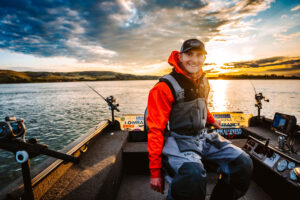

[…] Patterning the Unpatternable – Mapping Fish on the Missouri River […]