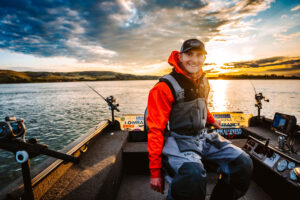
Lake Francis Case is a popular walleye fishery and after a stretch of tough fishing, punctuated by a down year in 2024, the fishery has found itself in the spotlight. Fortunately, signs are pointing towards a rebound and the fishery remains a walleye factory.
Lake Francis Case is the 11th largest reservoir in the United States, stretching 107 miles and covering 102,000 surface acres. The reservoir was created when Fort Randall Dam was constructed, which occurred between 1946-1952, and reached minimum operating pool in November 1953. The reservoir now has a max depth of 140 feet.
South Dakota Game, Fish and Parks (GFP) fisheries biologists sample the fishery in September with 75 gill nets, which are set between 8-99 feet at random locations across the waterbody. These survey results were then shared at a virtual public meeting February 17, 2026.
What Species are in Lake Francis Case?
The most common species caught in these gill nets were walleye, which comprised 31% of the total catch. Sauger constituted 9% of the total catch, making 40% of the fish sampled walleye or sauger. Channel catfish came in at 20%, with smallmouth bass at 8%, and gizzard shad, the primary forage within the reservoir, at 2%.
In addition to walleye, sauger, channel catfish, smallmouth bass, and gizzard shad Lake Francis Case is also home to a unique paddlefish population, as well as white bass, yellow perch, freshwater drum, goldeye, and other species.

How Does Runoff Impact Lake Francis Case?
The Lake Francis Case walleye population has a strong relationship with runoff in the reservoir. While Lewis and Clark Lake below Lake Francis Case is negatively impacted by high runoff, Lake Francis Case is positively impacted. This is because this runoff brings nutrients into the reservoir and in turn produces forage for young of the year walleye.
In years of high runoff, higher walleye abundance can be expected. In years of low runoff, lower walleye abundance can be expected. The recent trend of low runoff has resulted in lower walleye abundance, but Lake Francis Case remains a productive walleye factory and has proven to produce a year class season after season.
What are the Walleye Numbers on Lake Francis Case?
The 2025 sampling results indicated walleye abundance greater than 2023 and 2024, and on par with 2017-2022 numbers. Overall, walleye abundance was five fish per net, and indicates an increasing trend in total walleye abundance.
Of the walleyes sampled, 45% of fish are over 15 inches with 9-10% of these fish over 20 inches. A strong number of age-6 fish, which were produced in the high runoff year of 2019, remain in the population and are between 18-19 inches. A healthy number of smaller fish are also waiting to take their place as well, with a strong number of fish age-3 and below.
Electrofishing is used to sample age-0 walleye, and while 2025 was a lower catch rate at 55 walleyes per hour, Lake Francis Case continues to consistently produce year classes. On average, walleyes per hour are often around 150.
How is Walleye Growth on Lake Francis Case?
Walleye growth rates in Lake Francis Case are excellent, and fish are both growing quickly and in very good overall condition.
A healthy relative weight, or Wr, is around 80. On Lake Francis Case, relative weight averages between 80-90, usually between 80-85. This is largely influenced by the amount of forage, and was a contributing factor to the tough fishing in 2024, when Wr was at 90. In 2025, this number was closer towards the average at 85.
In addition to being in excellent shape, walleye grow quickly in Lake Francis Case. Typically, the goal is to have a walleye at 15 inches by age-3. Lake Francis Case walleye are well exceeding this metric, reaching 16 ½ inches by age-3 and 18 inches by age-5.

What is the Harvest Rate on Lake Francis Case?
The bulk of angler usage, as well as walleye harvest, takes place between April and July. Creel surveys are conducted to determine angler hours, walleye catch rates, and walleye harvest. Additional questions will also be asked in these creel surveys as well to gather further data on the fishery and angler usage.
The 2014-2025 average is 526,000 angling hours, and 2025 was slightly behind this at 470,000 hours. The catch rates are right at the long term average of 1 fish per hour, which is nearly triple other major walleye fisheries such as Lake Erie that sees .3 fish per hour.
Anglers released 353,000 walleyes in this time frame, harvesting 95,000. This was behind average, which is 154,000 walleye harvested and 381,000 walleye released. The average walleye kept was right at 16 ¾ inches.
Learn More: Angler Harvest Thoroughly Evaluated on Lake Francis Case

Will Lake Francis Case Be Stocked This Year?
Lake Francis Case currently does not receive walleye stockings, and fish are naturally produced within the reservoir. Lake Francis Case is commonly referred to as a walleye factory, and this is due to the consistent year-classes produced year after year. Despite decreased production due to decreased runoff, these trends have remained true in recent years.
How is the Lake Francis Case Paddlefish Fishery?
The unique Lake Francis Case paddlefish season continues to be popular among anglers. Held throughout the month of May and open to both snagging and archery, approximately 1,800 anglers apply for the 600 available licenses each season.
Paddlefish anglers caught .325 paddlefish per hour in 2025, which exceeds the average of .278 fish per hour. A total of 256 paddlefish were harvested in 2025, and 1,315 paddlefish were released.
What Should Anglers Expect for Lake Francis Case in 2026?
Anglers should expect fishing to continue to rebound in 2026. Walleye abundance is trending upward, the fish are in excellent condition, growing quickly, and year classes continue to replace fish that are caught.
Forage will continue to be a major factor, and increased overwinter survival of gizzard shad could be a hindrance on the bite similar to 2024. If gizzard shad survival is closer to normal, catch rates should continue to remain around average or improve.
Changing conditions on the fishery continue to be the biggest impact to angler success, and areas that have traditionally produced have been producing at much lower rates in recent years. Fishing trends are continuing to change, and anglers that adapt to these changes are finding the most success.
There is plenty of fish over 15 inches to be caught, as well as smaller fish to keep anglers entertained. Overs, or those fish larger than 20 inches, are also present in the system and make up about 10% of the population based on sampling data.
The eyes will continue to be on Lake Francis Case in 2026, and the walleye factory is ready to produce another year of fish. Gizzard shad survival, angling techniques, and runoff will all play a major factor in 2026 and anglers should stay on top of these trends to maximize their success.

The Complete Guide to Fishing Lake Francis Case
Anglers looking to learn more about tactics, techniques, and baits for Lake Francis Case can find all of this and more in The Complete Guide to Fishing on Lake Francis Case.