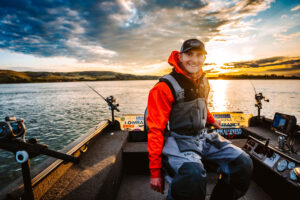
Lewis and Clark Lake is a popular waterbody in southeast South Dakota and offers a variety of water recreation opportunities including fishing, boating, swimming, and kayaking. Sitting along the border of South Dakota and Nebraska, Lewis and Clark Lake is located near Yankton and the close proximity to Sioux Falls, Sioux City, and Omaha makes it a popular waterbody.
The reservoir is 69 miles long, stretching from Fort Randall Dam in Pickstown to Gavins Point Dam below Yankton. Featuring both a riverine and a lake stretch, the reservoir covers 19,279 surface acres and reaches a max depth of 45 feet in the lake section.
The upper end of the reservoir features a riverine and delta area, with current playing a major factor in this stretch of the reservoir. The lower end functions as a lake, and features decreased current and deeper water.
To sample the fishery, South Dakota Game, Fish and Parks (GFP) fisheries biologists place 36 gill nets in random areas within the lake section. Electrofishing is also conducted to monitor the population of age-0 walleye and track recruitment to the system. The results of these survey results were then shared at a virtual public meeting on February 17, 2026.
What Species are in Lewis and Clark Lake?
The three most abundant species in Lewis and Clark Lake are channel catfish, gizzard shad, and freshwater drum. Overall, walleye comprised 6% of gill net catches, and sauger added an additional 7%. In total, the walleye and sauger population constitutes approximately 13% of fish sampled within Lewis and Clark Lake.
Lewis and Clark Lake is known for excellent channel catfish fishing, and there are both good numbers and good size of catfish within the fishery. The bulk of the catfish in the reservoir are between 16-24 inches, with larger catfish present as well.
Lewis and Clark Lake is also home to a strong population of smallmouth bass. Anglers can expect a healthy number of fish between 12-14 inches, with fish larger present as well.
How Does Runoff Impact Lewis and Clark Lake?
In Lewis and Clark Lake, walleye abundance can be closely correlated to runoff. Runoff and walleye abundance has an inverse relationship, meaning that when runoff is high walleye abundance will be low and when runoff is low walleye abundance will be high.
This is because water moves very quickly through this reservoir, and the decreased runoff means water, and in turn nutrients, will be more available for newly hatched walleye. When runoff is high, water will spend very little time in the reservoir and thus these nutrients will be less available for these young fish.
What are the Walleye Abundance Numbers?
Several years with below average runoff has resulted in above average walleye abundance. There is a strong number of walleye age-4 or younger, with excellent recruitment seen in age-0 walleye electrofishing.
The vast majority of walleye are between 15-20 inches, and a healthy number of fish continue to be working their way up to take their place. Electrofishing for age-0 walleye has been fantastic, with approximately 100 walleye per hour between 2023-2025. This is over double the average between 2008-2025, which is 44 walleye per hour.
Sauger abundance is very similar, with higher abundance from 2023-2025. Similar to walleye, the bulk of the fish present in the fishery are between 15-20 inches.
How are Walleye Growth Rates?
Walleye growth rates in Lewis and Clark Lake are among the best in the state. Walleye in Lewis and Clark Lake reach 15 inches by age-2, which is a full year ahead of normal benchmarks. By age-3, walleye are reaching 17 ½ inches.
Walleye are also in excellent condition. Relative plumpness, or Wr, is measured by taking a fish’s length by weight. A healthy value is 80, and Lewis and Clark Lake walleye are exceeding this metric. On average, walleye condition in Lewis and Clark Lake is between 85-95, and in 2025 Wr was again 89.
Sauger grow slightly slower than walleye, reaching 14 ½ inches by age-2 and 16 ½ inches by age-3. Both of these metrics are still excellent, and indicate a healthy population of both walleye and sauger present within the fishery.
Will Lewis and Clark Lake Be Stocked This Year?
Lewis and Clark Lake will not be stocked in 2026 due to the excellent natural production the reservoir has seen in recent years. Nearly all of the recruitment in 2023 was naturally produced, and there were no stockings in 2024 nor 2025.
Despite no stocking, walleye production in the fishery has been fantastic due to low runoff conditions. The projected low runoff year in 2026 and excellent number of fish seen in recent years means no stocking will be conducted in 2026, and fisheries biologists anticipate more above average natural production.
How is the Gavins Point Dam Paddlefish Fishery?
The Gavins Point Dam paddlefish seasons are both popular and unique opportunities, featuring a snagging season through the month of October and an archery season through the month of June. Both of these seasons are offered through lottery draw applications.
The last 2-3 years, snagging season paddlefish catch rates are closer towards historical numbers between 1997-2003, with anglers catching .18 fish per hour. In 2025, 321 paddlefish were harvested, with 29 being above 45 inches.
The 2025 archery season saw 138 fish harvested, with 60% of the fish harvested above 35 inches. This continues a trend of success following a regulation change in 2016 when success rates were near 25%, and are now near 60% success rates.
Learn More: 2026 Gavins Point Dam Paddlefish Status Report

What Should Anglers Expect for Lewis and Clark Lake in 2026?
Anglers should expect another good year of fishing on Lewis and Clark Lake, with both strong numbers of walleye and sauger to be caught. The bulk of these fish are between 15-20 inches, and smaller fish are present in the system as well.
Multispecies fishing opportunities for channel catfish, smallmouth bass, white bass, and other species can also be expected. Channel catfish in particular are in very good shape, and an excellent number of quality catfish are present. Smallmouth bass fishing can also be very productive for average quality fish.
Lewis and Clark Lake can fly under the radar for walleye fishing opportunities, but the past few years has shown the best of what the fishery can offer. In 2026, anglers should expect more of the same.

Learn More About South Dakota Fisheries
The Lewis and Clark Lake forecast and status report is one of several status reports done on popular South Dakota fisheries. Find more, and learn about other topics, in our South Dakota Fisheries Focus page!