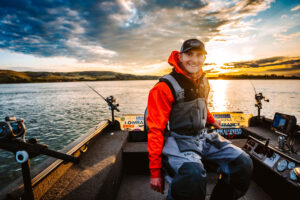
Lake Francis Case is one of the most popular walleye fisheries in the region, and as a walleye factory angler harvest plays a critical role in the recruitment, growth, and mortality of the walleye population within the reservoir.
Of these three management elements, harvest is directly tied to mortality in terms of walleye populations. South Dakota Game, Fish and Parks (GFP) fisheries biologists closely monitor this harvest by creel surveys. These surveys provide an important glimpse into the angler usage of the fishery, and the 2025 results were shared at a virtual public meeting February 17, 2026.
Angling Pressure
The bulk of the angler usage on the reservoir takes place between April and July, which sees both the greatest usage and harvest throughout these months. It is during this time these creel surveys are conducted.
Between 2014-2025, anglers averaged 526,000 hours fishing on Lake Francis Case. In 2025, angler hours were slightly below average, coming in at approximately 470,000 hours. In the past four years, these hours were right around average.

Walleye Catch Rates
Catch rates, or the time it takes anglers to catch a walleye, are also a critical component of fisheries management. In 2024, a period that correlated to poorer fishing due to increased prey abundance, catch rates were about .5 fish per hour. In 2025, catch rates returned back towards the long term average, coming in at 1 fish per hour.
Lake Erie, and other prominent walleye fisheries, target .3 fish per hour. Lake Francis Case is commonly referred to as a walleye fishery, and these catch rates support this as they often triple some of the other best walleye fisheries in the region.
Walleye Harvest
In the surveyed period in 2025, anglers released nearly 353,000 walleyes and harvested 95,000. Both of these numbers were slightly behind average, which is 381,000 walleyes released and 154,000 walleyes harvested.
Walleye Released April-July:
- Average: 381,000
- 2025: 353,000
Walleye Harvested April-July:
- Average: 154,000
- 2025: 95,000
In addition to quantifying hours fished, walleyes caught, walleyes released, and walleyes harvested, creel surveys also will ask anglers specific questions that relate to fisheries management.
Specific creel survey questions discussed the topic of fishing guides and live imaging sonar, also referred to as forward facing sonar.

Live Imaging Sonar/Forward Facing Sonar
Of anglers surveyed, 77% did not use live imaging sonar on their trip while 23% did.
Did you use live imaging sonar?
- No: 77%
- Yes: 23%
Of the anglers that did not use live imaging sonar, walleye catch rates were 1.29 fish per hour. This exceeded the catch rate of anglers that did use live imaging sonar, which was .94 fish per hour.
Fish Per Hour:
- No Live Imaging: 1.29 fish per hour
- Using Live Imaging: .94 fish per hour
Of the anglers that did not use live imaging sonar, 28.3% had a limit of walleye. By comparison, anglers that were using live imaging sonar had a limit 24.1% of the time.
Walleye Limit by Method:
- No Live Imaging: 28.3% limits
- Using Live Imaging: 24.1% limits
Guided Fishing Trips
Of anglers surveyed, 95% were not on a paid, guided fishing trip while 5% were.
Is this a paid, guided fishing trip?
- No: 95%
- Yes: 5%
Anglers who were not on a guided fishing trip caught 1.19 fish per hour, while anglers that were being guided caught 1.61 fish per hour.
Fish Per Hour:
- Not Guided: 1.19 fish per hour
- Guided: 1.61 fish per hour
Anglers who were not on a guided fishing trip had a limit 26% of the time, while anglers that were being guided had a limit 57% of the time.
Walleye Limit by Trip:
- Not Guided: 26% limits
- Guided: 57% limits
Whether guided or not guided, the size of the walleye harvested was identical. Non-guided anglers had an average walleye of 16.75 inches, and guided anglers had an average walleye of 16.76 inches.

Walleye Tagging Study Upcoming
In addition to the standard creel surveys, fisheries biologists will be beginning a walleye exploitation study this spring. Walleye exploitation is studied by tagging fish, and measuring the number reported to be harvested by anglers.
In the spring of 2026, 1,500 walleye will be tagged across the fishery. The reservoir will be split into three zones: upper, middle, and lower, to better assess the complete aspect of the fishery. Each zone will receive 500 tags, and there will be 300 reward tags of the total 1,500. Reward tags are worth $100, and there will be 100 per zone.
Tags can be reported to tags.sd.gov or to a local GFP office. Reward tags will indicate “REWARD” on them, and must be confirmed by fisheries staff at an office or via picture online.
Anglers play a critical role in fisheries management, and can do their part by answering creel survey questions when asked by fisheries staff, reporting any tagged fish they catch, and of course purchasing their license. All of these factors play a critical role in the management of these fisheries, and are key for fisheries biologists to effectively do their job.
Lake Francis Case is a popular walleye fishery, and anglers enjoy this fishery in a variety of ways. In total, angling pressure and harvest was slightly below average in 2025, but anglers continue to catch and harvest quality fish in very good numbers.

Learn More About Walleye Fishing on Lake Francis Case
Anglers looking to learn more about walleye fishing throughout the season, including locations and techniques, can find everything they need to know and more in The Complete Guide to Fishing on Lake Francis Case. Whether it’s spring walleye fishing or the middle of summer, this guide breaks down everything there is to know about targeting walleye on Lake Francis Case.

Lake Francis Case Walleye Population Continues Positive Trend
The Lake Francis Case walleye population has been a subject of discussion in recent years, as anglers have reported a bit tougher fishing on the reservoir. The toughest bite was in 2024, and the 2025 season showed signs of improvement. Heading into 2026, these signs continue to point towards an upswing in the walleye fishing on the 107-mile-long reservoir.