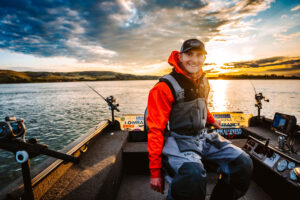
Lake Sharpe is known as a walleye factory, and production was good in 2025. Lake Sharpe is an action fishery that consistently produces excellent numbers of walleye, and anglers should expect more of the same in 2026. In addition to walleye, special attention has been paid to the Lake Sharpe smallmouth bass population and fisheries biologists are attempting to create a paddlefish opportunity within the fishery. Learn more about that, and more, in the 2026 Lake Sharpe Fishing Forecast and Status Report.
Each September, South Dakota Game, Fish and Parks (GFP) fisheries biologists conduct gill net surveys through the bottom ⅔ of the reservoir, as the current is too strong to effectively sample in the upper end. There are 50 nets set from De Grey Lakeside Use Area to the face of the Big Bend Dam. West Bend Recreation Area serves as the halfway point, with 25 nets set above and 25 set below.
In addition to these nets, to sample the upper end of the reservoir, scuba surveys take place from May through September. This involves two divers floating 10-20 minute transects each month. They note the number of fish observed, then walleye per kilometer is calculated. Scuba survey results are then compared to traditional gill net surveys, as well as flows through Oahe Dam, to paint a greater picture of the Lake Sharpe fishery.
This information is then shared at a public meeting, which was held at the AmericInn in Fort Pierre in January 2026. Notably, while fisheries biologists split Lake Oahe into two management zones – Upper Oahe and Lower Oahe, this is not necessary for Lake Sharpe. Lake Sharpe is the second smallest reservoir in the Missouri River system, and the smaller size allows fisheries biologists to focus on it at a reservoir level.
What are the Walleye Abundance Numbers in Lake Sharpe?
Walleye abundance was right at average in 2025 according to gill net surveys. This is consistent with previous years, as Lake Sharpe is known for consistent natural recruitment. A deeper dive into the data shows further consistency, with the number of fish ranging from 10-15 inches and 15-20 inches similar to previous years. Fish greater than 20 inches are uncommon in Lake Sharpe, and while they are present, the bulk of walleye within the system are less than 20 inches.
While known more as a numbers fishery over a trophy fishery, walleye harvest is an important element of the reservoir. Gill net surveys are conducted in September, which is after the bulk of the walleye harvest by anglers is complete, and over 25% of walleyes sampled were greater than 15 inches. There is also a considerable number of fish just below 15 inches, which will be of legal harvest size for the coming season.
How are Walleye Growth Rates on Lake Sharpe?
Walleye growth rates were just below average in 2025, with fish reaching 14.3 inches by age-3. The benchmark fisheries biologists look for is for walleye to reach 15 inches by age-3, which shows Lake Sharpe walleye tracking slightly behind this rate.
However, a deeper dive into the data for Lake Sharpe indicates growth rates remain on average for what the fishery has seen historically. Walleye were approximately 14 inches at age-3 from 2017-2019, before reaching 15 inches at age-3 from 2020-2024. Length at age-3 had slightly trailed down since 2021, but still remains within the historical 14-15 inch range historically seen within the fishery.
How is the Walleye Condition in Lake Sharpe?
Walleye condition is evaluated by taking a length by weight comparison, referred to as “Wr” by fisheries biologists. An ideal Wr for walleye is between 80-90, and Lake Sharpe walleye are consistently right around 80. In 2025, walleye condition on Lake Sharpe was just slightly below average.

How is the Gizzard Shad Population in Lake Sharpe?
The Lake Sharpe walleye fishery is driven by gizzard shad, with shad being the primary forage within the reservoir. While there is no way to formally quantify shad abundance and distribution, fisheries biologists rely on anecdotal evidence from time spent on the reservoir doing management activity.
The bulk of the gizzard shad observed is within Hipple Lake within Farm Island Recreation Area, and fisheries biologists electrofish this area to move fish from Lake Sharpe into Lake Oahe for its shad stockings. In previous years, gizzard shad capture has been among its highest.
Electrofishing for smallmouth bass in May also produces an excellent opportunity to observe shad, and fisheries biologists observed significant numbers of gizzard shad throughout the reservoir, particularly on the lower end. Areas such as Joe Creek, Iron Nation, and Counselor Creek had adult gizzard shad rivaling numbers seen within Farm Island Recreation Area.
While it is not possible to say where all these shad distribute throughout the reservoir, it can be safely assumed that there is adult gizzard shad spawning throughout the entire reservoir. It is also important to note that gizzard shad can spawn multiple times in a year, and as long as the water is above 55 degrees gizzard shad will conduct spawning activity resulting in multiple young-of-the-year gizzard shad in the fishery.
When are the Most Walleyes in the Oahe Dam Tailrace?
Walleyes observed in the Oahe Dam tailrace through scuba survey vary dramatically on a month to month basis, which coincides with what anglers see in the area as well. Traditionally, fall is considered the best time to fish the Oahe Dam tailrace and scuba survey results mirror this as well.
Walleye numbers are quite low in May, with this consistently the lowest numbers of walleye observed. Walleye numbers begin to increase in June, and will hold steady through July, until numbers begin to drastically increase by late summer.
Generally speaking, walleyes per kilometer will double in the August survey, with this number doubling yet again by September. Walleyes per kilometer often sit around 10 in June and July, before moving to 20-30 in August and 50-60 in September. All of this agrees with angler information, that late summer and fall is the best time to fish the Oahe Dam tailrace.
Current through the dam is a major factor in this as well. The two highest years of scuba survey took place in 2018 and 2019, which coincides with a period of high flows through the Oahe Dam. Conversely, walleye abundance in gill nets further downriver were low, indicating that when water is flowing and food is being flushed through the dam, walleyes will utilize this area earlier in the year and in greater numbers.

What was Fishing Pressure on Lake Sharpe?
GFP fisheries biologists alternate creel surveys every year between Lake Oahe and Lake Sharpe. In 2025, the creel survey was conducted on Lake Oahe, which means in 2026 Lake Sharpe is due to be creeled. Fishing pressure is quantified each year for both reservoirs.
In 2025 fishing pressure was right at average for Lake Sharpe. This followed a year of increased pressure in 2024, although fishing pressure was down in 2023. The most recent creel survey, 2024, indicated anglers were slightly more successful than average. Lake Sharpe averages 1.2 walleyes caught per hour, and this number slightly ticked up, 1.3 walleyes per hour, in 2024.
A walleye tagging study will also take place in 2026 and 2027, and fish will be captured in the spring, jaw tagged, and harvest exploitation will be evaluated. The most recent jaw tagging study took place from 2017-2022. Harvest exploitation was below 20% from 2017-2020, and moved into the 25% range from 2021-2022. Acceptable harvest exploitation is 20-35%, indicating that walleye harvest is well within acceptable levels.

What are the Smallmouth Bass Harvest Rates?
Smallmouth bass in Lake Sharpe have been the focus of study by GFP fisheries biologists, with an emphasis on smallmouth bass harvest and size distribution. This was evaluated through a jaw tagging study, population modeling, and angler opinion survey.
The results of the jaw tagging study showed that harvest exploitation of smallmouth bass was between 20-37%, which is significantly higher than expected. When compared to walleye harvest rates, which were 8-25% from 2017-2022, it can be safely stated that a larger percentage of the smallmouth bass population is harvested by anglers than the walleye population.
Population modeling based on fishery sampling data showed strong support for a 15 inch minimum length limit for smallmouth bass. Modeling data suggests this length limit could double the number of 14 inch bass in the fishery and lead to 2.5 times more bass greater than 17 inches.
An angler opinion survey supports this minimum length as well. A random sampling of anglers who have fished Lake Oahe or Lake Sharpe in the past five years showed 51% supporting the regulation, 40% neutral, and only 9% opposed.
The results of all of these studies has GFP fisheries biologists considering a 15 inch minimum length limit for both Lake Sharpe and Lake Oahe. This is currently working through the rule promulgation process and could be proposed to the GFP Commission in July 2026 before finalization in September 2026. If the regulation completes this process, it could go into effect January 1, 2027.
Learn More: Lake Sharpe Smallmouth Bass Harvest Study Results

How is the Paddlefish Population?
Paddlefish were a common species in the Missouri River prior to dam completion, which decreased spawning habitat and impacted migration routes. In 2015, paddlefish reintroduction efforts began on Lake Sharpe with the ultimate goal of developing a sport fishing opportunity within the fishery.
For the past decade, 17,000-44,000 juvenile paddlefish have been stocked each year. These stockings occur in the upper end of Lake Sharpe, and paddlefish are now being observed within the stilling basin, Hipple Lake, and Oahe Dam tailrace.
Fish that have been successfully captured by fisheries biologists are averaging approximately 14 pounds, and the majority of the population is less than 36 inches. Recapture efforts have not been able to successfully quantify the overall paddlefish population within the fishery, and a study beginning in 2026 with South Dakota State University will focus on developing sampling and assessment techniques for this growing population.
Learn More: Lake Sharpe Paddlefish Population Continues to Be Evaluated

What Species are in Lake Sharpe?
Fisheries biologists evaluate the species caught within the gill nets to get a relative abundance of the overall population within the fishery. In 2025, gill net catches consisted of 39% walleye, 4% sauger, 20% channel catfish, 12% smallmouth bass, and 8% yellow perch with smaller percentages of other species.
In total, over 40% of the fish sampled were walleye or sauger. It is also worth noting that not all species are effectively caught in gill nets, or may use a different area of the reservoir, for example paddlefish are monitored through netting efforts in the stilling basin and not included in traditional gill net surveys.

What Should Anglers Expect for Lake Sharpe in 2026?
All signs are pointing towards another productive year in the Lake Sharpe walleye factory. Walleye abundance remains right on average with a strong supply of fish over 15 inches in the system, and a healthy crop of fish that were just below ready to take their place.
Walleye growth rates are also near average, with fish taking 3-4 years to reach 15 inches overall. While condition and growth at age-3 was slightly down in 2025, both metrics remain right near average indicating yet another steady year within the fishery.
Anglers should expect plenty of fish to be caught, with a balance of both those “keeper”, or 15 inch, walleyes, and the “shorts” or those just slightly below. Anglers are also encouraged to report any tagged fish they catch to tags.sd.gov, and to be involved in the GFP Commission process for a potential 15 inch minimum length limit for smallmouth bass.
Overall, Lake Sharpe remains one of the most consistent walleye fisheries in the state and anglers can expect more of the same good fishing heading into 2026!
Learn More: Lake Sharpe Walleye Population Remaining Steady