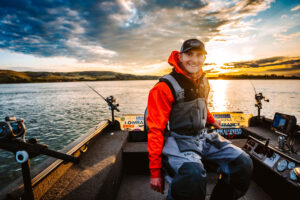
Fishing was fantastic on Lake Oahe in 2025, and all signs are pointing to an even stronger 2026! Walleye abundance continues to increase, walleye are growing at a quick rate, and the other fishing opportunities such as salmon and smallmouth bass are providing an excellent bite as well. Learn more about all of that, and more, in the 2026 Lake Oahe Fishing Forecast and Status Report!
Each September, South Dakota Game, Fish and Parks (GFP) fisheries biologists conduct gill net surveys across the reservoir. There are 216 gill nets placed within the waterbody from Pollock to Peoria Flats. This information is then shared at an annual public meeting, which was held at the AmericInn in Fort Pierre in January 2026.
What is the Difference Between Upper and Lower Oahe?
GFP fisheries biologists split Lake Oahe into two management zones – Upper and Lower Oahe. The two zones are split at the 212 bridge near West Whitlock Recreation Area in Gettysburg.
Upper Oahe is known for strong walleye abundance, smaller size structure, and good natural recruitment. Lower Oahe is known for lower walleye abundance, larger size structure, and poor natural recruitment.
However, in recent years, the inverse has been true. Lower Oahe is seeing a higher walleye abundance than Upper Oahe, as well as stronger growth rates. Additionally, recruitment had been down in recent years on Upper Oahe and growth rates were poor. Fortunately, both ends of Lake Oahe have promising news heading into the 2026 season.
What are the Walleye Abundance Numbers?
Walleye abundance is increasing on both Upper Oahe and Lower Oahe. In 2025, lake sampling reports by GFP fisheries biologists are indicating a higher walleye abundance on Lower Oahe than Upper Oahe, but both have seen abundance increases as a whole.
Sampling from 2025 on Upper Oahe saw a slight increase in walleye abundance from 2024 and just slightly below 2023 walleye abundance. This continues a positive trend of increasing abundance compared to 2017-2022, when walleye abundance was significantly lower than current levels.
Sampling from 2025 on Lower Oahe saw a continuing increasing trend, and is the highest walleye abundance since 2017. The bulk of these fish are between 15-20 inches, with a considerable number of fish greater than 20 inches. At face value there is a decreased number of fish between 10-15 inches, but this is explained by rapid growth rates.
How are Walleye Growth Rates on Lower Lake Oahe?
The decreased number of fish between 10-15 inches can be explained by significantly increased growth rates observed on Lower Oahe. Ideally, walleyes reach 15 inches by age-3. Walleyes on Lower Oahe are a year ahead of this growth benchmark.
On Lower Oahe, walleyes are reaching the 15 inch mark by age-2 and reaching nearly 17 inches by age-3. Specifically, age-3 walleyes were 16.9 inches. This means that fish are spending less time in the 10-15 inch size class, and more time in the 15-20 inch range.
It takes approximately 7 years for walleyes to reach the “over” category, which is 20 inches. On average, age-7 walleyes are reaching 20.6 inches. This means that there are roughly five year-classes within the 15–20-inch bracket, which is why there is an ample number of the “eater” caliber fish to be caught on the reservoir.
Learn More: Walleye Growth Rates Cause for Excitement on Lower Lake Oahe

Has Fishing Improved on Upper Lake Oahe?
Fishing has been steadily improving on Upper Oahe, which includes both increasing abundance and increasing walleye growth. Walleye abundance from 2023-2025 has significantly increased when compared to 2017-2022, and more noteworthy is a greater number of fish between 15-20 inches.
One aspect of this is steady natural recruitment in recent years, which has led to more fish on the upper end of the reservoir. A larger component of this rebound is increased growth rates. This increase began in 2023, with walleyes reaching 14 inches by age-3 in 2024 and 15 inches by age-3 in 2025.
This is a significant improvement when compared to 2021 and 2022, when walleye length at age-3 was only about 12 inches. From 2018-2022, walleye length at age-3 had not exceeded 14 inches, which makes the 15 inch mark in 2025 that much more important and impressive.
Learn More: Upper Lake Oahe Shows Both a Rebound and Promising Future

What is the Stocking Plan for Lake Oahe?
Stocking efforts by GFP fisheries staff have played a major role in the increased abundance and growth rates along the reservoir. Walleye stockings began in 2021, and alternate each year between Lower and Upper Oahe. This is to prevent a stockpiling of fish in a certain area, which could reduce growth rates.
Annually 2.1-3.5 million walleye fingerlings have been stocked into the fishery. These alternating stockings have played an important role in increased walleye abundance on Lower Oahe, and in 2026 these stocked fish should begin to show up for both anglers and in lake surveys.
In addition to walleye stockings, gizzard shad stockings have provided an additional forage option for fish within the reservoir and played an important role in increasing walleye length at age-3. Gizzard shad are an excellent food source for growing walleyes quickly, and are a major reason fish are reaching 15-17 inches by age-3 within the reservoir.
While the 2026 stocking plan is not finalized, the focus is going to be concentrating gizzard shad stockings on Upper Oahe to further improve walleye growth rates on this end of the reservoir. The excellent growth rates on Lower Oahe are the reason biologists are able to concentrate these efforts on the upper end, where growth rates have been slower.
Learn More: Stocking Efforts Paying Dividends for the Lake Oahe Walleye Fishery

What is the Fishing Pressure on Lake Oahe?
The excellent fishing on Lake Oahe drew more anglers to the reservoir in 2025, with fishing pressure reaching levels that were observed during the 2020 covid pandemic. Following the “covid boom”, angling pressure had leveled out from 2022-2024, before increasing again in 2025.
While fishing pressure was just about the same on both Upper and Lower Oahe, angler catch rates were significantly different. On Upper Oahe, anglers targeting walleye caught 1.42 walleyes per hour. On Lower Oahe, anglers targeting walleye caught .40 walleyes per hour.
The abundance of forage on Lower Oahe likely played an important role in these decreased catch rates. When walleyes are well fed, fishing becomes difficult. This is also another element to why fisheries biologists will be focusing gizzard shad stockings on Upper Oahe, which should help angler catch rates on Lower Oahe.
Learn More: Hot Bite Sees More Anglers Fishing Lake Oahe

How is the Smallmouth Bass Fishing on Lake Oahe?
Smallmouth bass fishing continues to be excellent on Lake Oahe. The bulk of the fishing occurs on Lower Oahe, which has deeper, cooler, and clearer water as well as more gravel and rock, which is ideal smallmouth bass habitat.
Smallmouth bass abundance on Lower Oahe is at its highest level since 2018, with an increasing number of fish greater than 15 inches. In previous years, 80-90% of the smallmouth bass population was less than 15 inches. Fortunately, there is a number of fish larger than 15 inches present in the reservoir.
While the story is not as positive on Upper Oahe, with decreasing smallmouth bass abundance, this is not the primary smallmouth range on the reservoir. On both Lower and Upper Oahe, growth rates for smallmouth bass are positive.
Learn More: Lower Lake Oahe Smallmouth Bass Population on the Rise

How is the Salmon Fishing on Lake Oahe?
The most unique fishing opportunity in the state, the Lake Oahe salmon fishery, continues to have a strong population of fish. This is due to increased stockings in 2023 and 2024, where over 710,000 and 479,000 fish were stocked respectively.
Salmon on Lake Oahe have about a two year life cycle, which means the 2023 fish were both available for anglers and returned to the spawning station in 2025. Egg collection was good, and conditions are set for another 650,000 fish to be stocked in 2026. This means there should be another good number of fish for anglers to catch, and return to the station as well.
Learn More: 2026 Lake Oahe Salmon Fishing and Stocking Report

How is the Forage Conditions on Lake Oahe?
There is a significant amount of forage available throughout the reservoir. Smelt numbers are at their highest since 2016, which continues a trend of increasing smelt abundance over the past 6-8 years. Conversely, ciscoe numbers have been decreasing since their peak in 2022.
Smelt and ciscoe have an inverse relationship. This is because ciscoe will spawn in late fall, and as these newly catched ciscoe emerge in the spring smelt are moving into the spawning grounds. This makes smelt a major predator on newly hatched ciscoe, which means when there is an abundance of smelt ciscoe numbers are often decreased.
The various forage species within Lake Oahe all serve different roles. Smelt are very good for growing smaller to medium sized walleyes, and while a big walleye will eat smelt they tend to prefer ciscoe. Ciscoe are a much larger body prey species that aren’t able to be consumed by smaller walleye, but are an ideal meal for trophy caliber sized fish.
Energetically, one ciscoe can feed a trophy caliber walleye while it would take significantly more smelt to achieve the same input. The increased ciscoe numbers played a major role in the state record setting big walleye craze that overtook the reservoir in 2023.
Both of these species have their own niche, and a healthy balance is best for the fishery. While smelt offer a food base for small to medium walleyes, the larger walleyes then can key in on the ciscoe. It is also important to note that when looking from a total number standpoint, even when there are low smelt numbers they still rival the best ciscoe numbers.
Gizzard shad also serve an important role in the growth of walleyes on Lake Oahe, as gizzard shad can offer a similar food source as smelt. Gizzard shad provide an ideal food source for small to medium walleye, primarily those under 20 inches, and can grow fish very quickly. Contrary to smelt, gizzard shad are a warm water species, which compliment the cold water species that is smelt. This combination means there is a food source in all areas of the system.
What Species are in Lake Oahe?
A percentage by species is calculated from gill net catches, which determines a relative population abundance between the variety of species found within the reservoir.
On Upper Oahe, the 2026 gill net surveys saw 48% channel catfish, 27% walleye, 5% smallmouth bass, 4% yellow perch, and 1% white bass among primary game species within the fishery. On Lower Oahe, gill net surveys saw 32% channel catfish, 30% walleye, 24% smallmouth bass, 3% yellow perch, and 2% white bass.
In whole, about ⅔ of the fish caught in gill nets are channel catfish or walleye. Channel catfish abundance is higher on Upper Oahe, while smallmouth bass abundance is higher on Lower Oahe. This has to do with the warmer, more turbid water on Upper Oahe and cleaner, cooler water on Lower Oahe.
What Should Anglers Expect for Lake Oahe in 2026?
The 2026 forecast for Lake Oahe is incredibly positive. The increased walleye abundance means there is plenty of fish for anglers to target, and concentrating gizzard shad stockings on Upper Oahe should increase angler harvest success on Lower Oahe.
Walleye fishing should be very good throughout the reservoir, with a significant number of fish to be caught between 15-20 inches. In terms of “overs”, the number of fish between 20-25 inches should be strong, and the possibility of a trophy is always present on Lake Oahe.
Similarly, smallmouth bass anglers should expect plenty of action with great numbers of bass to be caught. Also similar to walleye, there is always the possibility of a trophy caliber smallmouth at any time. Salmon anglers should experience good fishing as well, with increased number of fish present in the system thanks to larger stockings.
Whether it is to fill a limit, the fish of a lifetime, or to enjoy the variety of species Lake Oahe has to offer anglers should make plans to hit the water in 2026!

Learn More About South Dakota Fisheries
Learn more about Lake Oahe, Lake Sharpe, and all the other fisheries across South Dakota in our South Dakota Fisheries Focus page!