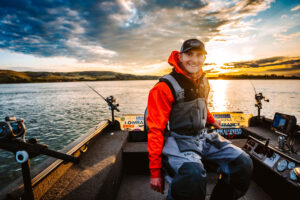
Increasing abundance, quality sized fish, and an overall hot bite brought more anglers to Lake Oahe in 2025, returning back to angling pressure seen during the “Covid Boom” of 2020. That’s according to South Dakota Game, Fish and Parks (GFP) fisheries biologists who shared an update at a public meeting January 2026 at the AmericInn in Fort Pierre.
Angling pressure on Lake Oahe was at its highest in 2020, which corresponded to the “Covid Boom” of increased angling pressure as a whole. Angling pressure then evened out in the following years, with 2022 seeing a significant drop-off. This pressure remained level through 2024, but bumped up again in 2025.
Angling pressure was consistent between both Upper and Lower Lake Oahe and was right at the same levels of 2020. While 2020 felt like an anomaly, the increased abundance and good fishing brought anglers back to the fishery in strong numbers.
Learn More: Walleye Growth Rates Cause for Excitement on Lower Lake Oahe
GFP fisheries biologists rotate creel surveys between Lake Oahe and Lake Sharpe. Creel surveys focus on angler hours, effort, and catch rates. In 2025, Lake Oahe was up for creel survey.
In 2025, Upper Oahe saw a 1.09 walleye catch rate per hour and Lower Oahe saw a .33 walleye catch rate per hour. When focused specifically on anglers targeting walleye, these catch rates increase to 1.42 walleyes per hour on Upper Oahe and .40 walleyes per hour on Lower Oahe.

While overall walleye abundance was higher on Lower Oahe in 2025, catch rates were inverse. This is because of the abundance of forage present in the system, specifically on the lower end, with gizzard shad, rainbow smelt, and ciscoe all offering food sources for walleyes. When fish are growing quickly and in good condition they are eating well, which can be a detriment to catch rates.
To address these catch rates, and because of the excellent growth rates on Lower Oahe, GFP fisheries staff will be focusing their gizzard shad stockings on Upper Oahe in 2026. In previous years, gizzard shad stockings had taken place throughout the reservoir. Ample forage on Lower Oahe, and slower growth rates on Upper Oahe, allows fisheries biologists to focus their efforts on kick starting growth on the upper end.

In addition to a creel survey, a jaw tagging study also took place on Lake Oahe in 2025. To conduct this survey, fisheries biologists catch walleye, place a metal tag in their jaw, and return them to the fishery. Anglers who catch these walleyes are then encouraged to report their unique jaw tag number to tags.sd.gov, and information is collected on catch and harvest rates.
Biologists then evaluate the number of tags returned within one year. In 2025, walleyes were tagged in April and May. This means that while results are not yet official until April/May of 2026, early results are showing significantly reduced angler exploitation.
Historical trends date back to 1999-2003 and 2013-2016. Between 1999-2000, walleye exploitation on Lake Oahe was 17%. Between 2001-2003 walleye exploitation was 22%. It is important to note that these years were following a major flooding event in 1997.
While the earlier jaw tagging study focused on all of Lake Oahe, the 2013-2016 results were split between Upper and Lower Oahe. In 2013, Upper Oahe saw 24% exploitation and Lower Oahe saw 32% exploitation. The 2014 numbers were 18% for Upper Oahe and 19% Lower Oahe. Exploitation increased in 2015, with 27% exploitation on Upper Oahe and 39% on Lower Oahe. The final year of the study, 2016, saw 15% exploitation on Upper Oahe and 27% on Lower Oahe.
Overall, exploitation was 17-22% from 1999-2003 and 15-39% from 2013-2016. It is important to note that both of these events occurred after floods in 1997 and 2011. This explains why there was a higher percent of fish harvested as fish were not growing as quickly, forage was not plentiful, and overall conditions were not very good within the fishery.
The opposite is true for 2025, as there is both an abundance of walleye and forage in the system. Supported by strong natural recruitment, stocking efforts, and rainbow smelt increasing, conditions are very good on the reservoir as a whole.
Learn More: Stocking Efforts Paying Dividends for the Lake Oahe Walleye Fishery
While numbers will go up a little bit more upon the completion of the survey, overall walleye exploitation will be much lower in 2025. Thus far, the 2025 walleye exploitation rates were 9.4% for Upper Oahe and 6.6% for Lower Oahe. This is significantly less than the 17-22% and 30-35% exploitation rates seen between 1997-2001 and 2013-2016.

Lake Sharpe Angling Pressure Remains Steady
Below the dam, fishing pressure on Lake Sharpe remained right at average following increased pressure in 2024. Lake Sharpe will be due for a creel survey in 2026 per the rotational basis with Lake Oahe.
In the most recent creel survey, 2024, Lake Sharpe saw 1.3 walleyes caught per hour. On average, Lake Sharpe averages 1.2 walleyes caught per hour. Lake Sharpe is known as a walleye factory, and these catch rates support that, with the national average being .35 walleye per hour.
Learn More: Lake Sharpe Walleye Population Remaining Steady

While catch rates are strong, angler exploitation is relatively low. An acceptable harvest exploitation is 20-35%, and the most recent jaw tagging results indicated Lake Sharpe was either below or well within acceptable. A jaw tag study between 2017-2020 was below 20%, and in 2021-2022 moved into the 25% range. Overall, walleye exploitation is well within acceptable range for a healthy fishery.
Another walleye tagging study will take place Spring 2026 and 2027. This follows a smallmouth bass jaw tagging study from 2023-2024, which indicated an above expected smallmouth bass exploitation. Smallmouth bass exploitation on Lake Sharpe was 20-37%, indicating that bass exploitation is considerably greater than walleye exploitation. This does not mean more smallmouth bass are being harvested, but a greater percentage of the bass population is.
Overall, it was a very good year of fishing on both reservoirs. The quality sized walleyes attracted anglers to Lake Oahe, and Lake Sharpe continued to be a walleye factory. Anglers should expect more of the same in 2026!

Learn More About South Dakota Fisheries
Individuals looking to learn more about fisheries across South Dakota can find details on Lake Oahe, Lake Sharpe, walleye, salmon, smallmouth bass, yellow perch, and more! Check out the South Dakota Fisheries Focus page to learn more!