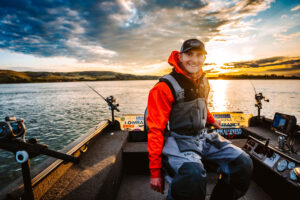
The Lake Oahe smallmouth bass population continues to increase on the lower end of the reservoir, with the highest abundance on Lower Oahe since 2018. That’s according to South Dakota Game, Fish and Parks (GFP) fisheries biologists, who shared an update at a public meeting in January 2026 at the AmericInn in Fort Pierre.
Smallmouth bass can be found throughout Lake Oahe, but the primary smallmouth bass range is on the lower end of the reservoir. GFP fisheries biologists split Lake Oahe into two zones – Upper Oahe and Lower Oahe. Both of these areas have specific characteristics, with Upper Oahe shallower, warmer, more turbid and featuring more shale and Lower Oahe deeper, cooler, clearer, and featuring more rock and gravel.
While smallmouth bass are present on Upper Oahe, it is on Lower Oahe they find the water and habitat conditions that they prefer. For comparison, on Upper Oahe about 5% of the fish caught in survey nets are smallmouth bass where on Lower Oahe about 24% of the fish caught in survey nets are smallmouth bass.
The total abundance of smallmouth bass on Lower Oahe is at its highest since 2018, with about 3.5 bass per net. While survey results are seeing an increasing number of smallmouth bass, the population is relatively dominated by fish less than 15 inches. There has been some improvement in fish over 15 inches since 2023, which is compared to 80-90% of the population being less than 15 inches from 2018-2022.
Compared to previous years, the size structure is showing a steady number of fish less than 10 inches, and a bit more bass between 10-15 inches. Fortunately, the size structure indicates the best number of fish between 15-18 inches since 2018 and an average number of fish over 18 inches. As a whole, the number of bass less than 15 inches would be considered the majority of the population.
The growth rates for bass in Lake Oahe are relatively quick but compared to walleye growth rates there is a significant difference. Where a walleye on Lower Oahe is reaching 17 inches by age-3, it takes nearly triple that, 8 to 9 years, for a smallmouth bass to reach 17 inches.
Learn More: Walleye Growth Rates Cause for Excitement on Lower Lake Oahe
For additional comparison, it takes smallmouth bass about 5 years to reach 15 inches, where walleyes on Lower Oahe are reaching 15 inches by age-2. While smallmouth growth rates on Lake Oahe are strong, they are not comparable to walleye growth rates for a species by species comparison.
Lower Lake Oahe Smallmouth Bass Growth by Age:
- Age 1 – 6.8 inches
- Age 2 – 9.8 inches
- Age 3 – 12.1 inches
- Age 4 – 13.8 inches
- Age 5 – 15.3 inches
- Age 6 – 16.1 inches
- Age 7 – 16.3 inches
- Age 8 – 17.4 inches
- Age 9 – 18.0 inches
- Age 10 – 18.5 inches

The story on Upper Oahe is a bit different, with smallmouth bass abundance continuing to decrease and at the lowest total abundance since 2018. While this abundance is tracking down, as noted Upper Oahe sees a far lower abundance overall than Lower Oahe. The biggest reason behind this is the water and habitat conditions.
While there are less bass, similarly to Lower Oahe the fish are growing quickly. Smallmouth bass on Upper Oahe are also reaching 15 inches by age-5, and cracking the 17 inch mark by age-8.
Upper Lake Oahe Smallmouth Bass Growth by Age:
- Age 1 – 6.4 inches
- Age 2 – 10.2 inches
- Age 3 – 12.1 inches
- Age 4 – 13.7 inches
- Age 5 – 15.1 inches
- Age 6 – 15.6 inches
- Age 7 – 16.3 inches
- Age 8 – 17.5 inches
- Age 9 – 17.5 inches
- Age 10 – 17.8 inches

The smallmouth bass population on Lake Sharpe has received considerable attention, and many of the trends seen within the Lake Sharpe population are also present in the Lake Oahe population.
Following public petitions regarding a regulation on smallmouth bass to increase the number of quality bass on Lake Sharpe to the GFP Commission, GFP fisheries biologists have been taking a deep dive into the smallmouth bass population. This has been done through jaw tagging, population modeling, and an angler opinion survey.
Learn More: Lake Sharpe Smallmouth Bass Harvest Study Results
A jaw tagging study from 2023-2024 showed smallmouth bass exploitation between 20-37% on Lake Sharpe, which when compared to walleye exploitation shows a much higher percentage of smallmouth bass being harvested than walleye. For comparison, walleye exploitation on Lake Sharpe showed harvest rates between 8-25%.
Population modeling evaluating a series of regulations shows support for a 15 inch minimum length limit on both Lake Sharpe and Lake Oahe. The analysis showed that when a 15 inch minimum length limit is applied, the number of 14 inch bass doubles and the number of 17 inch bass is nearly 2.5 times as many as current numbers.
Anglers also show support for this regulation, with a random sample of anglers who have identified fishing Lake Oahe or Lake Sharpe in the last five years indicating 51% of anglers would support a 15 inch minimum length limit on smallmouth bass and 40% neutral. In total, only 9% showed some level of opposition to this regulation.
These results have GFP fisheries staff evaluating this 15 inch minimum length limit for both Lake Oahe and Lake Sharpe, and the idea could be formally proposed at the July 2026 GFP Commission meeting. If accepted by the Commission, the proposal would then open for public comment for 60 days with final action set for September 2026. If approved, the regulation would be implemented in January 2027.
Despite the ongoing discussion, Lake Oahe, particularly the lower end of Lake Oahe, remains a quietly excellent smallmouth bass fishery. Whether an individual is a hardcore bass angler, or just a walleye angler looking to take advantage of this opportunity, there is plenty of smallmouth bass to target on the lower end of the reservoir. Anglers should make plans to check out this fishery, and see for themselves what bass fishing on Lake Oahe is all about!

Learn More About South Dakota Fisheries
Learn more about South Dakota fisheries, including Lake Oahe, Lake Sharpe, walleye, smallmouth bass, salmon, and more on our South Dakota Fisheries Focus page!