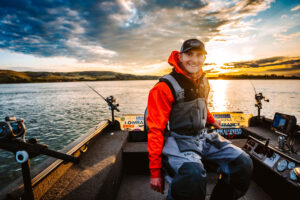
Lake Sharpe is commonly referred to as a walleye factory, and rightfully so, each year the fishery produces a constant supply of walleyes. Known as an action fishery, Lake Sharpe has a steady population of fish between 10-20 inches, with a 15 inch minimum length limit. In 2026, anglers should expect another year of bites and hooksets on the reservoir according to South Dakota Game, Fish and Parks (GFP) fisheries staff.

This update was shared at a public meeting in January 2026 at the AmericInn in Fort Pierre. Each September GFP fisheries biologists place 50 standard nets at random locations between 6-60 feet. Due to the current, this survey takes place in the lower ⅔ of the reservoir.
The northern boundary is De Grey Lakeside Use Area, with a halfway mark of West Bend Recreation Area. Half of the nets are placed on the northern side and half of the nets are placed on the southern side.
The 2025 catch was composed of 39% walleye, 4% sauger, 20% catfish, 12% smallmouth bass, and 8% yellow perch among primary game fish species.

2025 Walleye Abundance Right at Average
Overall, 2025 walleye abundance was near average from previous years. Survey results indicate yet another steady supply of fish working their way through the ranks, with numbers of both 10-15 inch fish and 15-20 inch fish on par with previous years.
Notably, 25% of the catch exceeded 15 inches, meaning they are legally harvestable fish. The timing of these surveys is also noteworthy, with sampling done in September when most of the season’s walleye harvest has already occurred. Surveys showed a strong number of fish between 14 ½ and 14 ¾ inches ready to replace these 15 inch fish as well.
The condition of the walleye, or relative plumpness, is right on average. Ideal condition, known was Wr, is 80-90. Lake Sharpe’s average walleye condition is right around 80, with 2025 walleye condition coming in just slightly below average.
Walleye growth at age-3 is also a critical component of fisheries management and an indicator of overall fish condition. Generally speaking on Lake Sharpe it takes 3-4 years for walleyes to reach the 15 inch mark.
From 2017-2019, walleyes were about 14 inches at age-3 before seeing that number reaching the 15 inch mark from 2020-2024. The peak was in 2021, with fish slightly exceeding 15 inches, before trailing back down in recent years. In 2025, walleye length at age-3 was 14.3 inches.

Current Has Biologists Diving into Results
In addition to standard net surveys, GFP has also been implementing a scuba survey to gauge the number of walleyes in the current below Oahe Dam. Instead of the traditional walleyes per net, which was just shy of 5 for 2025, abundance is measured in walleyes per kilometer floated. In 2025, walleyes per kilometer was about 10.
This is developed by tracking the distance that the divers travel in the water. Divers then report how many walleyes they observed, and fish per kilometer is calculated based on this metric. Walleyes per kilometer has varied from 5 to 35 fish since 2017.
The two highest years, 2018 and 2019, saw about 30-35 walleyes per kilometer. This coincided with a high flow period through Oahe Dam, which saw a significant amount of entrainment of walleye food and other forage through the dam. Walleye catch rates in traditional nets during this time showed a decreased number of fish, but scuba surveys showed an increased number of fish.
It can be confidently assumed that this high flow and increased forage resulted in many fish moving up the reservoir, which resulted in decreased fish sampled by nets and increased fish observed within the tailrace.
Diving deeper into this data, it can be assumed that high flow periods will concentrate fish in the upper end of Lake Sharpe as food is flushed through the dam. Conversely, in low flow periods fish are more evenly spread out through the reservoir.
Another indicator of the effectiveness of the survey is the fish observed by month. Fall is traditionally the best fishing in the tailrace, and this aligns with when the most amount of fish are observed. Scuba survey is completed each month May through September.
May is often the lowest amount of walleyes observed, with fish per kilometer less than 5. June sees an increase of fish, up to about 10 walleyes per kilometer, with July numbers very similar albeit slightly down.
As the calendar flips to August, walleyes per kilometer begins to increase with between 20-30 fish observed. This increases yet again in September, upwards of 50-60 walleyes per kilometer. Further indicating an influx of fish moving into the tailrace area as the season goes on and further supporting the excellent fall fishing that takes place in this area.
The combination of evaluating fish observed by month, the amount of current through the Oahe Dam, and traditional walleye netting results has indicated that scuba survey does appear to be an effective way to measure walleye abundance in upper Lake Sharpe.

The Factory Remains Up and Running
Overall, the walleye factory continues to be in normal operating condition. Walleye abundance is right on average, with a steady supply of fish working their way through the ranks. Approximately 25% of fish were greater than 15 inches, indicating a strong number of fish available for anglers and more fish coming to replace them.
Walleye growth and condition was slightly down, but still near average. Fish are growing slightly slower than in previous years, but still exceeding the benchmarks from 2017-2019. Fish condition is about the same, coming in just slightly below the average of 80.
All factors considered, Lake Sharpe’s walleye population remains steady. Lake Sharpe is a consistent fishery, and once again is supported by consistent recruitment and growth metrics. Anglers should plan for 2026 to be more of the same, with plenty of hooksets on Lake Sharpe!

Learn More About South Dakota Fisheries
Learn more about the Lake Sharpe fishery, as well as other fisheries within South Dakota, by checking out our South Dakota Fisheries Focus page!