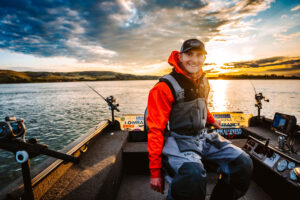
The more time we spend on the water, the more we have a favorite species to pursue. Many of us start fishing just hoping for a bite, often from small bluegill or other panfish, and continue to work our way up the species list until we find our favorite. It could be bass, muskie, or at least for myself, walleye. Being deemed a “walleye snob” is more of a compliment than an insult. However, it’s important to remember that while pursuing our favorite species becomes our goal, there are still many lessons that reside in multispecies fishing.
I had this reminder on a trip to Custer State Park in September 2025. I wanted to showcase the fishing opportunities present in the park, which meant I was focusing on catching rainbow trout. The trouble was, I know absolutely nothing about trout. I can’t fly fish. I don’t know what bait works. I don’t know what to look for. Heck if it wasn’t a rainbow I’m not sure I’d even be able to properly identify it!

Fortunately, it turned out I knew more about trout fishing than I thought. While I didn’t even realize it at the time, many of my lessons from fishing for other species were going to make me a trout angler. The end result-lots of trout caught and a very important reminder. The more fish we fish for, the more fish we catch.

That sounds like the ultimate “well duh” right? The more time you fish the more fish you catch. While this is true, there is no substitute for time on the water, targeting other species helps us learn more about the dynamics of fisheries and develop skills that we may not targeting our primary species.
Let’s break it down. I grew up targeting largemouth bass in eastern Nebraska throughout high school and had learned a couple lessons in doing so. One of the biggest lessons I learned was bass would use shadows to both stay comfortable and ambush their prey. I learned this lesson on Memphis Lake, which is literally between Omaha and Lincoln. The lake had a fantastic morning bite for largemouth bass, but once the sun came up the bite became extremely focused on one aspect-shadows.
The spot I fished was a relatively deep rocky grade, and right away in the morning blindly casting produced some fish. There truly was no rhyme or reason, the fish were just roaming around as there wasn’t a lot of structure in the area to hold them. That was until the structure was created by the sun, there were some large trees that were on the shoreline and as the sun rose it would cast large shadows across the bay I fished. Once these shadows started, the fish became predictable.
I could dissect these areas and cast right to the edges of this structure. Often, I was bit right as my bait entered into the shade or just as it was leaving it. As the sun grew higher, the shadows got shorter, and the bite fell apart. It was truly shadow dependent for about two hours and I had them dialed in.
Fast forward 12 years and I’m at the Grace Coolidge Walk-In Fishery in Custer State Park. This area features six low head dams that all are stocked with rainbow trout. They’re relatively shallow and lay out across a hiking trail that extends three miles through the Black Hills. The sun is shining, temperature is rising, and the first dam I stop at is in fully exposed sunlight.
I casted the dam with no success. I saw two trout, one just swimming and one half heartedly followed my bait in. I tried literally vertical jigging off the lowhead dam, as I am a walleye angler of course, as this was the only shade within the area. I had no bites, no fish, and not a lot of hope.
Heading up to the next dam the scene was different. Shadows were covering much of the water from the layout of the tall trees. I began by casting these shadows and was immediately rewarded. The same way the largemouth bass would relax and feed in this shade at Memphis Lake, the rainbow trout were doing the same. Casting into the shade and retrieving out, I was rewarded with many rainbow trout.

Heading up to the next dam was much of the same. The rainbow trout were holding along the edges of the shade, and while the fishing wasn’t as good at this dam that was likely because much of the deeper water was in the exposed sun. This reassured me that these shadows sprawling over the prime water was key, just as it was when I was in high school. Lessons I had learned over a decade ago continued to pay off.
The next piece of this puzzle was the bait I was using. In my head, traditional trout baits are hair jigs, inline spinners, and of course flies. As we stated, I’m not a traditional trout angler. I learned I did own two inline spinners, but the bait I selected was one I had confidence in. It was a size 4, the smallest made, Berkley Fishing Shallow Money Badger.

This bait is very similar to a Salmo Hornet, what I do know is a proven trout bait. I had also become extremely confident with the Shallow Money Badger while I was trolling crankbaits at Eagle Lake in August 2025. I followed that confidence up by casting it at the Oahe Dam tailrace and catching a number of smallmouth bass. I know the bait catches fish; I have every reason to believe it should catch trout too.
Sure enough, the Shallow Money Badger did indeed catch fish. I caught every fish of my trip, which included rainbow trout, largemouth bass, northern pike, and bluegill on the Shallow Money Badger. Every single one of them hit it aggressively, just as I thought they would.

Another lesson that presented itself was that many of these trout would follow the bait without actually striking. Fishing for muskie, I knew the traditional “figure eight” and other triggering mechanisms for when fish were following and incorporated these from time to time. Sure enough, I was able to convince a few trout to bite right at the end of my cast from this lesson. I didn’t deploy a complete figure eight, but I did catch them but either speeding up or slowing it down as I watched a trout follow.
I left Custer State Park with a lesson in multispecies fishing. A key component of my location, shade, was a lesson I had learned growing up targeting largemouth bass. My bait was one of my go-to walleye baits, simply because I had confidence in it. I scored several other bites from lessons I learned muskie fishing when fish are following. Again, the more fish we fish for, the more fish we catch.
The best anglers are able to catch fish anywhere at any time. This applies for their favorite species or a species they’ve never targeted before. The more time we spend on the water, and that goes for any water, the better we become. Try somewhere new. Target a new species. Tie on a new bait. You’re going to be rewarded with both a feeling of satisfaction and a lesson you can apply every time you hit the water. Good fishing!

Multispecies Fishing on Legion Lake
Legion Lake is one of the best multispecies fisheries in Custer State Park, and offers rainbow trout, largemouth bass, northern pike, and crappie for anglers to pursue. Learn more about this gorgeous fishery in Multispecies Fishing on Legion Lake in Custer State Park.

Hiking into Custer State Park’s Most Unique Fishery
The Grace Coolidge Walk-In Fishery is one of the most unique fisheries in the state, with a hiking trail leading six lowhead dams. All of these dams are full of rainbow trout and each feature a unique style of fishing. Learn more about this area in Fishing the Grace Coolidge Walk-In Fishery in Custer State Park.