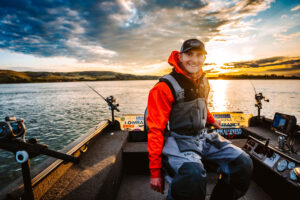
Hot weather, high sun, summer thunderstorms, and deep water walleyes. For anglers across the Midwest, these four elements all seem to go hand in hand. Fortunately, that doesn’t necessarily have to be the case! When it comes to targeting walleye on natural lakes in the mid-summer, one of the highest percentage areas is going to be shallow, weedy bays.
When fishing across eastern South Dakota, Minnesota, or up into Canada there is no shortage of shallow bays that are full of submerged vegetation. These areas are hot beds of life, with everything from aquatic insects, young-of-the-year fish, frogs, and of course predators! While these shallow weedy bays attract northern pike and muskie anglers, many walleye anglers overlook them. The fact is, these areas offer angling opportunities for everything from yellow perch and bluegill to muskie, pike, and of course walleye too!

The reason these bays are so attractive to all species of fish is they offer everything an individual species may need. Bluegill, largemouth bass, yellow perch, and crappie thrive in these areas-feeding on the abundant aquatic insects and juvenile fish that call this vegetation home, while also using it as cover to hide from predators. These predators-walleye, pike, and muskie, utilize the vegetation for the same reason. Their prey is present, and they can find comfort and shade sinking beneath the weed stalks when they need to. These areas also provide nursery habitat for fish of all of these species, completing the cycle of life present within them!
A common mistake many anglers make is thinking of walleye as bottom oriented, non-aggressive fish. This could not be further from the truth. Walleye, especially big walleye, similarly to northern pike and muskie are apex predators. They will aggressively chase forage throughout the entire water column, whether that is suspended over 60 feet of water or across the tops of weeds in 6 feet of water.
Walleye anglers that venture into these areas are often going to find the most success by fishing a variety of techniques. Casting a slipbobber onto structural elements, such as rocks, contour breaks, and pronounced vegetation pockets, can be an effective method. Similarly, dropping a jig between these weed pockets or just on the outside edge can produce fish too. However, when the bays are large and the fish are scattered amongst them, the best approach is to cover as much water as possible.

I experienced a perfect example of this when visiting Eagle Lake in August of 2025. This was my first time ever fishing Eagle Lake, and one of the most pronounced patterns I found was a shallow, weedy bay adjacent to a complex of islands. The vegetation itself only grew out to about 12 feet, and was predominantly in less than 10 feet of water, topping out between 6-8 feet below the surface throughout the bulk of this area. The deep water adjacent to this was mostly void of vegetation, and ranged anywhere from 13-20 feet.
This bay was full of yellow perch, most of these were under 6-7 inches, and thus attracted good numbers of northern pike, walleye, and while we didn’t catch one I can assume a couple muskies made their way through as well. The walleye were all in a size class that were large enough to eat these yellow perch, mostly 16-24 inches, and while there were a few smaller walleye present this wasn’t a numbers bite. However, if you’re looking to catch fish over 20 inches on a consistent basis, this is the spot to do it!

In the mornings and the evenings, the best bite was fishing directly above the weed stalks in 8-10 feet of water. Trolling crankbaits on leadcore allowed us to set our depths just above the very tops of the weeds, and the fish would come up and aggressively hit them. Our top options were a #5 Rapala Shad Rap, 6.75 Berkley Shallow Money Badger, and a #9 Berkley Shallow Hit Stick. Fishing these on traditional leadcore set ups, we were able to pinpoint the depth they ran.
The most common visitor to our lines were these small yellow perch, which while a nuisance, told us we were fishing in the right spot. Sure enough, after 4-5 little perch would strike, the rod would bend with something much heavier! In many instances this was a great quality Eagle Lake slot fish, or a fish between 18-23 inches, though there were a few fish reaching 24-25 inches and numerous mid-20 inch northern pike as well.
As the morning went on, these fish would become less active and as opposed to marking them on the tops of the weeds you would see them sink down towards the bottom. Many times, there were also a segment of fish that would slide to the bottom and sit in slightly deeper water just adjacent to this weed edge. They wouldn’t go far, maybe a few yards at most, but when you’d start to mark fish in 12-14 feet in areas you had not earlier, you know this transition is occurring.
This is when it’s time to mix it up and switch tactics. In this scenario, bottom bouncing with spinners right along the edges of these weed beds is particularly effective. While these fish are not actively feeding, they often aren’t in negative moods either. These are the classic “neutral” type fish, that while they may not chase a crankbait above them they may take a presentation offered directly in front of their nose.

While trolling crankbaits across the top of the weed stalks doesn’t necessarily have a set route, bottom bouncing these weed edges does require a good understanding of where the weeds sit in relation to the contours. If you get too far away from this vegetation, you won’t see many fish. If you get too close, your rod will bend, but it will be from salad as opposed to walleye.
Trust your electronics, both your mapping and your down imaging, to ensure you’re near the weeds and still on fish. In some instances, you may not even mark the fish you catch, they may just come out of the nearby weeds to take your bait. Your electronics will also tell you when it’s time to switch it up, when fish aren’t showing up on top the weeds it’s time to look on the edges and vice versa. It’s fascinating to watch the transition on your screen, and by doing so you can ensure you’re always in the highest percentage areas.
The approach is simple, make sure you have a couple trolling rods and a couple bottom bouncing rods ready to go. Start your day up high, trolling aggressively across the tops of the weed stalks. As the bite slows down, try a couple passes just on the edge of the weed line, when you see fish tight to the bottom it’s time to mix it up. Drop the bottom bouncers and continue to grind out bites until the sun starts to set. As evening approaches, it’s time to get the crankbaits back out and pull across the tops of weeds to end the day.
When the mid-summer heat pushes many anglers to the main lake structures, pull into a shallow, weedy bay and take a look around. In many instances, you’re going to find good sized, active fish, and a strong multispecies bite that will keep you busy throughout the day! Mix up your approach, and you’re sure to find some mid-summer weedline walleye!

Two Ways to Fish Shallow Weedline Walleyes
Two of the top ways to target walleyes in the weeds are trolling crankbaits and bottom bouncing. We discuss both of these tactics, and when to implement each one, in today’s video Two Ways to Fish Shallow Weedline Walleyes!
Host Site: North Shore Lodge
Our visit to Eagle Lake was hosted by North Shore Lodge near Eagle River, Ontario. Our favorite bay for fishing this type of bite was directly across from camp, which gave us ample time to piece this bite together across the weed! It made for a perfect spot to fish right after breakfast, or sneak out for a few hours after dinner, which was all provided by the lodge!