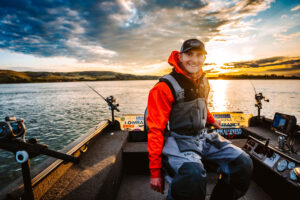
As the calendar flips to August, temperatures continue to rise, and the thoughts of the upcoming school, football, and hunting seasons all come to mind it’s easy to forget about walleye fishing. For many anglers, the mid-summer blues can hit hard, and the belief is that walleyes have slid out into the deep water, only to return when temperatures finally begin to cool in fall. However, there continues to be a great bite shallow often all summer long!

Weedy bays are common across the Midwest, particularly in eastern South Dakota, Minnesota, and up into Canada. While many anglers first might think of these as home for pike, largemouth bass, bluegill, or perch, walleye anglers who head into the vegetation as well will often find some excellent fishing waiting for them too. The reason is simple, the same forage that is keeping all these fish present is available for walleye too!
Submerged vegetation is a plethora of life when it comes to the ecosystem within a waterbody. This vegetation conducts photosynthesis, allowing it to grow, and provides a home for everything from microscopic invertebrates to trophy-sized muskie! This vegetation provides cover for newly hatched young-of-the-year fish species, frogs, and small panfish. This in turn will attract predatory fish, such as largemouth bass, pike, and walleye. The wide range of species present makes any submerged vegetation a go-to spot for walleye anglers looking to beat the mid-summer lull!
There are a variety of ways to target these areas, with slipbobbers or casting shallow crankbaits or plastics the first thought that comes to mind, but when conditions are right anglers can find the highest percentage chance of getting bites being trolling crankbaits across and beside this standing vegetation.
The best submerged vegetation for walleye is going to be with stalks that top out about halfway up the water column. This allows the fish to sink down into the weeds to find shade and comfort, while moving up to forage. It’s when these fish move up they can be easily targeted by anglers. A great example of this occurred on Eagle Lake in Ontario in August 2025.
“When it came to finding numbers of quality walleye, my best spots were large weedy bays adjacent to deeper water,” said Nick Harrington, Owner of Lip Ripper Fishing. “There was an abundance of 17-23 inch walleye that were keying on small yellow perch within these weed stalks.”

The best locations within these bays were when the weeds grew out into 8-12 feet of water, and topped out about halfway up the column between 4-8 feet below the surface. This made it easy to set the crankbaits right at the tops of the weeds, and cover water effectively searching for active fish that were up feeding and roaming within this bay. Once depths slid out to 12-15, the weeds stopped but there would still be walleye sitting on the outskirts of these edges as well, making them a viable candidate for trolling techniques, albeit just slightly deeper, as well.
While reading the graph to stay on top of both water depth, and the height of the stalks within the column, one of the most effective ways to know if the bite is going to be working is the presence of small yellow perch swiping at the crankbait. When these perch are presenting themselves, that means the walleye that feed on them are close behind!

“Our best fish finders were the small perch themselves,” stated Harrington. “It seemed that we would have a peck-peck-peck from perch, many times reeling them in, then all of the sudden the rod would bend and it’d be the right one you’re looking for.”
Crankbaits do not have to be complex, and many times the smaller, simpler baits are the best options. A small, #5, Rapala Shad Rap or Berkley Flicker Shad, is an effective way to keep your presentation directly across the top of these stalks. Larger bodied and deeper diving baits will often foul up quickly, and can make fishing much more difficult.
“Our top option for sure was a #5 Rapala Shad Rap,” continued Harrington. “Blue was the best color, but Purpledescent caught some fish as well. These two outproduced even the natural perch colors too.”
Trolling crankbaits in this fashion is more effective than slipbobbering, casting presentations, or jigging because it keeps the baits in the strikezone, across the most water, the longest. These techniques are better off deployed where there are pockets within the vegetation, contour elements, rocks, or other structural elements that will concentrate fish in a certain location within these areas.
“Slipbobbers are a good option because you can set your bait right in the strikezone, but when fish are scattered you’re spending more time hoping and less time fishing,” described Harrington. “Dropping a jig between the stalks offers the same issue, and the same can be said for casting crankbaits, you need a concentrated pocket of fish to fish this way.”
Bottom bouncers can be effective on the outskirts of these weed edges, which can be effective in the middle of the day when fish are sunk down and closer to slightly deeper water, but these are often low percentage chances as fish are less active than when they are up on top of the weeds actively feeding. When the fish are up and feeding, fishing directly across the top of them with a crankbait is key, and trolling allows anglers to cover the most ground and thus contact the most active fish.

“Trolling crankbaits is one of my favorite tactics for walleyes wherever they swim, and I think too many anglers think it has to be a deep water type of situation for crankbaits to be successful,” concluded Harrington. “If you can find a situation where fish are scattered among the weeds and get your bait directly on top of them, you’re going to catch fish.”
Trolling crankbaits also is an excellent way to locate active fish, then follow up and maximize bites with slipbobbers or casting crankbaits once fish have been located and are found to be concentrated. Whether fishing in eastern South Dakota, northern Minnesota, or up into Canada anglers who target bays with shallow vegetation are going to find both forage, and walleye!

Trolling Crankbaits for Weedline Walleye on Eagle Lake
Trolling shallow weedlines was one of our most consistent methods to catching walleye on Eagle Lake in the middle of August, and we discuss the details of this presentation in our latest video Trolling Crankbaits for Weedline Walleye on Eagle Lake!
Host Site: North Shore Lodge
Our visit to Eagle Lake was hosted by North Shore Lodge near Eagle River, Ontario. Sitting on the northeast side of the fishery, there were several shallow bays with submerged vegetation within minutes of camp. This allowed us to maximize our time targeting these areas, and we were also able to enjoy excellent food and a comfortable stay throughout our trip!