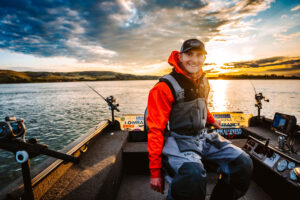
The Lake Sharpe smallmouth bass fishery has been receiving a significant amount of attention from South Dakota Game, Fish and Parks (GFP) fisheries biologists, and changes could be coming for the reservoir. An update regarding recent studies related to smallmouth bass on the reservoir was presented at a public meeting in January 2026 at the AmericInn in Fort Pierre.
This focus on the smallmouth bass fishery within Lake Sharpe originated from public petitions submitted to the GFP Commission asking for a reduction in bass harvested, as these anglers felt there were fewer quality sized bass in the system. These petitions prompted fisheries biologists to take a thorough evaluation of prospective bass harvest regulations, and how they may impact the fishery.
Throughout 2023 and 2024 jaw tags were placed on 3,440 smallmouth bass on the lower end of Lake Sharpe. Voluntary angler reports, which are submitted through tags.sd.gov, were then collected from anglers that catch and/or harvest these tagged fish. These tag results are used to determine angler exploitation and harvest rates.
While the sentiment among many anglers is that bass harvest is minimal or nonexistent, the results of this study showed the opposite. In 2023, harvest exploitation of smallmouth bass was 19.9%. In 2024, harvest exploitation of smallmouth bass was 37%. For comparison, a study from 2017-2022 on walleye exploitation showed harvest rates between 8-25%.
This showed that annual harvest exploitation of bass is between 20-37%, which is overall higher than the walleye harvest exploitation. This does not mean more smallmouth bass are being harvested than walleye by quantity but based on a percentage of the population.

A survey sent to anglers supported these results as well. A total of 13,000 anglers were surveyed, with 709 responses. Anglers who responded to fishing Lake Oahe or Lake Sharpe in the last five years were given an additional set of questions regarding their targeted and harvested species.
Of Lake Sharpe and Lake Oahe anglers, 80-85% reported that walleye were their primary target. Over half, 56%, reported harvested smallmouth bass within the last five years. This further discredited the sentiment that anglers will not harvest a bass and practice strictly catch and release.
When asked if they favored a 15 inch minimum length limit for smallmouth bass on Lake Sharpe and Lake Oahe, 51% overall supported the concept and 40% were neutral. Only 9% of anglers were opposed to this regulation, with 5% opposing and 4% strongly opposing this regulation. This is compared to 29% who strongly supported and 22% that supported the concept.
Population modeling also supports a 15 inch minimum length. Existing bass data was evaluated with both no limits and a 15 inch minimum length limit applied.
The analysis showed that with no harvest whatsoever, the smallmouth bass population could see about 30% of fish greater than 14 inches, with about 10% reaching 17 inches or bigger. This is due to factors such as natural mortality and decreased growth rates due to more fish within the population.
As harvest increases, the number of fish reaching 14 inches and 17 inches decreases. When compared to the current exploitation rates between 20-37%, the projected percentage of 14 inch bass is 10-20% and 17 inch bass is 1-5%.
When a 15 inch minimum length is applied, the model showed nearly double the number of 14 inch bass and 2.5 times as many 17 inch bass. This means from a management perspective, a 15 inch minimum length could significantly increase bass size structure within the fishery.

The results of the angler exploitation study, population modeling, and angler opinion survey have fisheries staff looking at next steps regarding a potential regulation change. A 15 inch smallmouth bass minimum length limit is currently being discussed within the GFP department, and could be formally proposed to the GFP Commission at the July 2026 meeting.
If this proposal is accepted by the Commission, it would then open for a 60 day public comment period, before receiving final action at the September 2026 meeting. If approved, implementation of this regulation would be as soon as January 2027.
The smallmouth bass fishery within Lake Sharpe is popular, and overall smallmouth bass harvest on the reservoir was higher than expected. GFP fisheries staff have thoroughly evaluated the best management for this population, and based on study and survey results that may be a 15 inch minimum length beginning in 2027.

Lake Sharpe Smallmouth Bass by the Numbers
Lake Sharpe Smallmouth Bass Harvest Exploitation:
- 2023: 19.9%
- 2024: 37%
Lake Sharpe Walleye Harvest Exploitation:
- Year One: 15%
- Year Two: 8%
- Year Three: 15%
- Year Four: No Data/Covid Year
- Year Five: 25%
Angler Survey Results on a 15 Inch Smallmouth Bass Minimum Length Limit:
- 29% strongly support
- 22% support
- 40% neutral
- 5% oppose
- 4% strongly oppose

Lake Sharpe Paddlefish Population Update
In addition to smallmouth bass, GFP fisheries biologists have also been assessing a reintroduced paddlefish population to Lake Sharpe. In 2026, GFP will begin working with South Dakota State University to further study the paddlefish population, with the goal of creating a sport fishery for this species.
View the Public Meeting Recording
A public meeting regarding the Lake Oahe and Lake Sharpe fisheries was held January 14, 2026 at the AmericInn in Fort Pierre. A complete recording of this meeting is available on the GFP YouTube page.
Learn More About South Dakota Fisheries
Information regarding fisheries across the state of South Dakota can be found on the South Dakota Fisheries Focus page. This details lake survey reports, walleye populations, forage, yellow perch, smallmouth bass, and paddlefish updates and highlights.