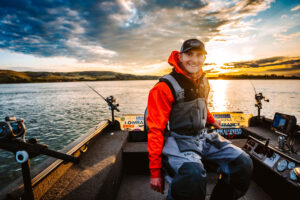
When the calendar flips to August, and mid-summer grips the region, there’s one sure bet to find big walleyes and that’s in deep water. There can be good fish found shallow in the weeds, or holding in a river mouth, but wherever walleye swim in the middle of summer there can be fish found in the deeper, cooler water. As I learned on my trip to Eagle Lake, this is as true for this fishery as every other one I have encountered!
Canadian summers can look a bit different, and while many of the mornings were indeed very chilly, and summer storms were keeping the temperatures in check, the same mid-summer walleye patterns held true. We were able to find some great quality fish in the shallow weedy bays, but as was expected the true giants were out along deep water structures.

The term “deep water” can vary widely from angler to angler. On Lake Oahe, deep water could be anywhere between 40-90 feet. On a prairie pothole slough in the Glacial Lakes region, this could be 10 feet. However, wherever walleye swim I categorize “deep water” as any depth at or greater than 30 feet. The same is true for Eagle Lake.
When it comes to finding deep water walleye, two key factors come into play. The first, and foremost, is forage. Cold water prey species, such as ciscoe, lake herring, and smelt, will all be roaming throughout depths anywhere between 30-100 feet. This means that their predators, in this case walleye, will be following closely behind them as well! If there is no forage, there’s not going to be fish present. However, where you can find forage, you’re going to find walleyes holding tightly to it and often be able to convince a coax a few bites.
This leads to the second factor, which is structure. Attempting to locate fish along sprawling basins, nonetheless, making them bite, is an extremely low percentage approach to fishing. The most important element is to find structural pieces, such as islands, humps, or reefs adjacent to this deep water. The closer the structure is to the deep water, and deeper the water, the higher percentage chance there’s going to be giants present.
The depth of the structure is important, but not critical. Anything ranging from 15-30 feet is going to hold fish, but the key is finding the deep water adjacent. If the deep water is 60 feet, there’s a higher percentage chance at a giant than if the deep water is 40 feet. Similarly, if fish need to go several hundred yards to access the deep water, it’s going to be a low percentage area. If you can cast from the structure to the deep water, you’re on a true trophy walleye spot!
There are two main ways to target these types of fish and structural elements: vertical jigging or trolling crankbaits. For many anglers, vertical fishing is greatly enhanced by the addition of front-facing sonar, and this technique continues to grow in popularity as these units become both more available and more affordable. For myself, I favor trolling crankbaits on leadcore line.
The reason I favor trolling crankbaits is I personally do not want to fish in depths greater than 30 feet. Once you get past 30 feet, the greater the depth you are fishing, the greater the probability that the fish you catch are going to experience mortality due to barotrauma. Barotrauma is a condition in which the fish’s air bladder, and in many cases eyes and other organs, experience drastic pressure changes and quite literally explode. Anglers who are fishing in these depths need to understand this is a consideration. If they wish to harvest the fish they catch, this is of no concern. If they wish to catch and release, this is very important.

Myself, I enjoy catching and releasing the vast majority of fish I catch. This means that I want to catch these fish at or less than 30 feet of water, and trolling leadcore allows me to set my baits at depths that do not get deeper than that in the column. This allows me to target fish suspended over deep water and this deep water structure as well. Regardless where I’m fishing depth wise on my graph, I know I’m not targeting a fish that’s deeper than the depths I set.
Large bodied and big billed crankbaits are a top option for two reasons. The first is it allows your bait to dive deeper, quicker, and thus less leadcore line is required. This gets you back to fish faster, and gets your fish in the boat faster too. The second is that these fish are often keying on large bodied cold water prey fish, such as ciscoe or lake herring, and thus are used to pursuing these larger meals.
Trophy caliber fish will also rarely waste energy on a small meal, and while big fish can be caught on jigs and minnows, the highest percentage is going to be larger bait profiles. This means that #9s and #11s are going to be the best bets, as they will dive deeper, fish more aggressively, and target the largest fish in the system.
A great example of this I found while fishing Eagle Lake was Barber Pole, a piece of structure that I could identify with a single rocking coming just out of the surface of the water. At closer inspection, I found depths reaching 60 feet extremely close to this structure. I focused my efforts targeting 22-32 feet of water, setting my baits 15-25 feet down. The clear water allowed me to attract these active fish from deep water, and target the large active fish roaming suspended chasing cold water prey fish.
Nearby structural elements, such as Walleye Rock 1 and Walleye Rock 2, at surface level look similar. However, closer inspection of these structural elements finds depths only reaching around 40 feet, and at a greater area of 30-35 feet as opposed to the drastic drop offs. While these pieces of structure are overall easier to fish, and hold greater numbers of fish, the top end trophy potential is greatly diminished.
When I was fishing Walleye Rock 1 and Walleye Rock 2, I favored a #7 Berkley Flicker Shad in Racy Shad or Blue Tiger. While I was fishing Barber Pole, I favored a #9 Rapala Shad Rap in Blue or Holographic Blue, as well as a #9 Blue Tail Dancer. The smaller profiled baits produced more bites, and thus more “eater” caliber fish, while the bigger profiled baits often caught the larger, over 20 inch, walleyes as well as a true trophy, 30 inch walleye too!

Wherever you’re fishing, when the calendar flips to August and mid-summer patterns are in full force, you can always expect to find big walleyes in deep water. Focusing your time and efforts on locating structural elements adjacent to this deep water, and understanding what makes a certain piece more likely to hold trophy caliber fish or numbers of fish is time well invested. When you optimize your bait style and profile to this structure, and the type of fish you expect to catch, the end result is often fish sliding into the net. I was fortunate to experience just that when I set out on my first trip to Eagle Lake, Ontario!
Deep Water Trolling Eagle Lake Walleye
Deep water trolling was one of the most effective ways to target big walleye fishing Eagle Lake in the middle of August, and we discuss all the details of this pattern in our latest video Deep Water Trolling Eagle Lake Walleye!
Host Site: North Shore Lodge
Our visit to Eagle Lake was hosted by North Shore Lodge near Eagle River, Ontario. Sitting on the northeast side of the fishery, we were within minutes of these deep water structures of Walleye Rock 1, Walleye Rock 2, and Barber Pole reef. The cabins were comfortable, food was excellent, and it presented a great base for our efforts patterning Eagle Lake walleye!